



















How to get referrals from B2B customers
How to get referrals from B2B customers: pick the right moment, ask a specific person for a specific introduction, make it easy and thank them.
 By the PromptLab team6 November 20265 min read
To get referrals from B2B customers, ask happy customers right after something has gone well, name the kind of company you want to meet, offer to write the introduction yourself, and say thank you whatever happens. A specific request to a specific person works far better than "do you know anyone?"
Product sellers have an edge: a customer who has just received a good delivery, a sample that worked or a smooth reorder has something concrete to say. This guide shows how to ask, when, and how to keep track. For ready-to-send wording, use the referral request email templates.
Why referrals work in B2B
Buyers trust other buyers. A purchasing manager who hears "they supplied us for three years and never missed a delivery" from a peer needs less proof than from a salesperson. Referred leads often move faster because the first meeting starts with trust.
Referrals also match how industries talk. Plant managers, formulators and buyers know each other across suppliers and trade shows. One mention can go a long way.
Step by step: ask for a referral
- 1
Pick the customers worth asking
Look for accounts that reorder, pay on time, have given positive feedback or just had a problem solved well. Say a packaging buyer has reordered four times and praised your delivery. That is your first ask. Skip customers with open complaints.
- 2
Choose the moment
Ask after a good outcome: a successful trial, a delivery that arrived early, a problem fixed, a renewal. Do not ask in the middle of an issue or straight after a price rise.
- 3
Name the kind of company you want
"Do you know anyone?" gets a shrug. "Do you know another food manufacturer who has the same cold-chain packaging problem?" gets a name. Describe the industry, size and problem you solve best. See your ideal customer profile.
- 4
Make it easy: offer to write the intro
Offer a two-line message they can forward: "Hi Sam, meet Anna from [Company]. They've supplied us for three years and might help with your film supply. Would you be open to a quick call?" The less work for them, the more likely it is sent.
- 5
Ask in the right channel
A call or a meeting for your best accounts, an email for the rest. If the customer uses WhatsApp or Telegram with you, a short message there often gets a faster reply. Keep it warm and brief.
- 6
Follow up and say thank you
Contact the introduced person within a day. Tell your customer what happened, win or lose. A thank-you note or a call closes the loop and makes the next referral easier.
When to ask
- After a successful sample trial or first order.
- After a problem resolved quickly.
- At a renewal or reorder.
- After positive feedback in a meeting or email.
- At a quarterly review with a key account.
Keep it honest and simple
Don't offer money or gifts that could be seen as a bribe, especially with buyers whose companies have gift rules. A thank-you note, a call or a small token within company policy is safer. Never pass on a customer's details without their agreement. They introduce you, not the other way round.
Track referrals
Record who introduced whom, the date and the outcome. Review them every quarter. You will find that a few customers produce most introductions, and those are the ones to look after. See how to increase repeat orders for keeping the base happy.
Mistakes to avoid
- Vague asks. "Anyone you know?" gives nothing.
- Asking once. A customer who said no in March may say yes after the next good delivery.
- Not following up. If you take a week to call the introduction, the warmth is gone.
- No thank-you. The person who helped should hear the result.
A worked example
Say a coatings supplier delivers a sample to a furniture maker, the trial passes and the first order ships early. Two days later the rep emails the purchasing manager: "Glad the first order landed well. You mentioned a supplier group meeting. Do you know another furniture maker with the same finish problem? I've written a two-line intro you can forward." The buyer forwards it to a colleague at a sister company. The rep calls the next day, mentions the buyer's name, books a meeting and tells the buyer the result. Total effort for the customer: one forward.
Repeat that with five accounts a quarter and referrals become a steady source of warm first meetings.
How PromptLab helps
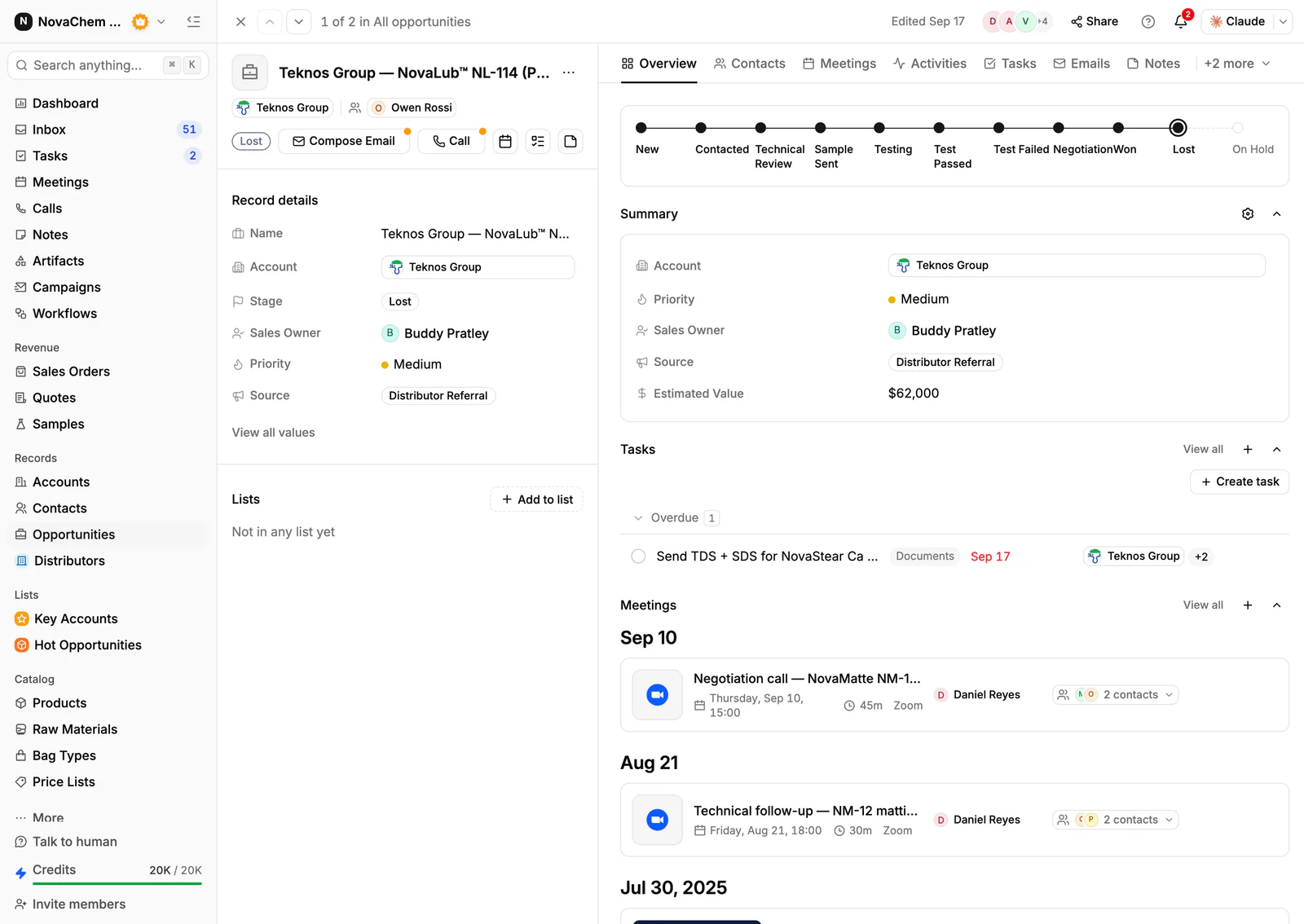
PromptLab keeps the history that tells you when to ask: the account's orders, quotes, samples, notes and meetings. Every deal has a Source, with Customer Referral and Distributor Referral among the choices, and you can add a custom field such as "Referred by" on the contact or deal, so you can filter and report on referred deals. A workflow can create a task when a sample's status changes, say to a positive result, or when a deal moves to a stage such as Won, so the ask is not forgotten. Your referral email can be sent from the CRM and replies land in the shared Inbox.
Frequently asked questions
When is the best time to ask a B2B customer for a referral?
Right after something has gone well: a successful trial, an early delivery, a fixed problem or a reorder. Avoid asking during a complaint or after a price rise.
How do you ask for a referral without being pushy?
Ask for one specific introduction, explain why, and make it easy by offering a draft intro. Accept "not now" politely and ask again after the next good result.
Should you pay for B2B referrals?
Be careful. Cash or gifts can break the buyer's company rules and look like a bribe. A thank-you note, a call or a small token within policy is safer.
How many referrals should I expect?
It varies by industry and relationship. Treat it as a steady habit, with a few asks a month, rather than a campaign. Track them to see what your own rate is.
What should I do after receiving a referral?
Contact the introduced person within a day, mention who referred you, and tell your customer how it went. Log the referral in your CRM so you can thank and track it.