



















How to price products for B2B customers
How to price products for B2B customers: know your costs, set a base price, build customer price lists, set discount rules and review prices on a schedule.
 By the PromptLab team31 October 20265 min read
To price products for B2B customers, start from your full cost and the margin you need, set a base price per product, then build customer price lists for each group of buyers, with discount rules written down. Review the lists on a schedule, so prices move on purpose and not by accident.
This guide is for manufacturers, distributors and wholesalers. B2B pricing is different from retail: one product often has several prices, depending on who buys, how much and on what terms. The aim is a structure your whole team can follow, so two reps do not quote the same buyer two different prices.
Start with your real cost
A price built on a guess of cost is a price built on sand. For each product, add up:
- Materials or purchase cost, at the current supplier price
- Production or handling cost
- Packaging
- Freight in, and freight out if you deliver
- Duties, if you import
- Overheads you want each unit to carry
If you import, count everything it takes to get the goods to your door, not just the supplier's price. Then decide the margin you need. Gross margin and markup are not the same thing: a 25% markup gives a gross margin of 20%, and mixing them up is a common reason for under-priced lists. The margin and markup calculator does the arithmetic.
Set a base price per product
The base price, often called the list price, is the starting point. Three ways to set it:
- Cost-plus: cost plus a target margin. Simple, and a good floor. It ignores what the buyer will pay.
- Market-based: the price of comparable products from competitors, adjusted for your quality and service. It needs market knowledge.
- Value-based: the benefit to the buyer, such as lower scrap, longer life or fewer line stoppages. It works best for technical products where you can show the saving.
Most suppliers mix them: cost-plus for the floor, market for the range, value for the specialities.
Build price lists for each customer group
Different buyers deserve different prices only when there is a reason. Common groups:
| Group | Typical reason for a different price |
|---|---|
| Distributors | They resell, so you give them a margin to earn |
| Large direct accounts | Volume and a predictable repeat order |
| Small accounts | Higher cost to serve, smaller orders |
| Export markets | Freight, duties and currency |
| Contract customers | A fixed price for a fixed term |
Each group gets a price list. Say a pigment supplier has a standard list, a distributor list at a set discount, and a contract list for two large buyers. That is three lists to maintain, not three hundred special prices. How to manage customer price lists covers the upkeep.
Write discount rules
Discounts need rules, or they leak. Decide in advance:
- Volume breaks: the price at 100, 500 and 1,000 units, or by order value. See how to negotiate volume discounts.
- Payment terms: what you give for faster payment, and what you charge for longer terms.
- Who can approve what: a rep may give up to a set discount, a manager more, and nobody goes below the floor price without a director.
- What the buyer gives back: a larger order, a longer contract or a quicker decision. Never give a discount for nothing.
Handle price objections and increases
Buyers will push back. Know your answers before the call: what the price includes, what the cheaper offer leaves out, and what you can trade. How to handle price objections gives ready replies.
When costs rise, raise prices on a schedule and give notice. The price list update checklist helps you do it without losing the account.
Review prices on a calendar
Pick a review date, such as twice a year, and check:
- Whether costs have moved since the list was set
- Which discounts were given most often, and whether the list should absorb them
- Win and loss rates, and how many losses cite Price
- Margin by product and by customer group
Pricing is never finished. A short, regular review beats an emergency one.
How PromptLab helps
Keep products and customer price lists in the CRM, then pick the list on each quote. A quote shows the margin on each line, so the rep sees the effect of a discount before sending it. The quote exports as a PDF or goes out by a public link.
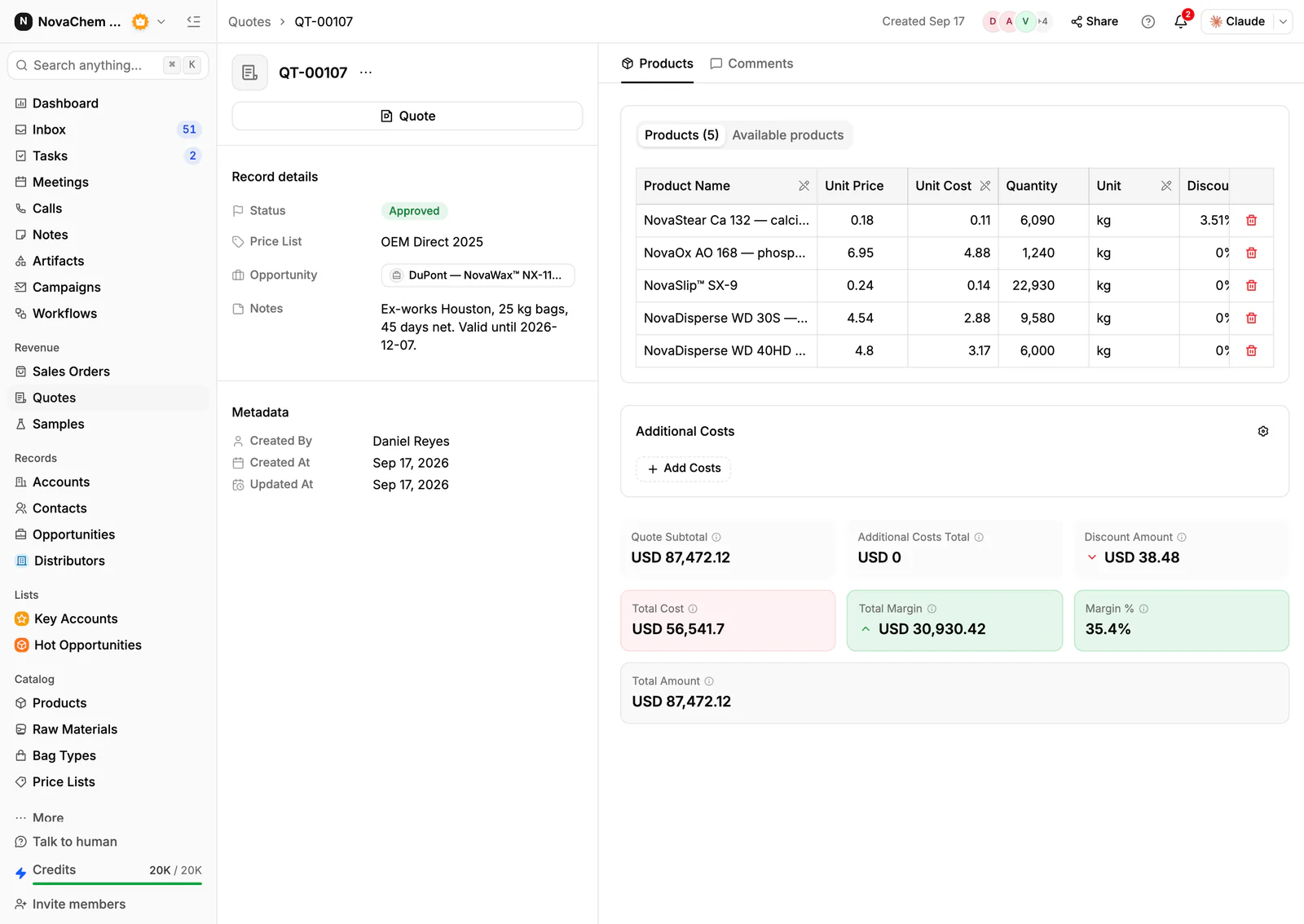
Editing a list's prices reprices every quote linked to it, so put a price change in a new list rather than editing the live one. Lost deals need a loss reason from a fixed list, including Price, which gives you the data for the review.
Frequently asked questions
What is the best pricing strategy for B2B products?
There is no single best one. Cost-plus gives you a safe floor, market-based keeps you competitive, and value-based earns the most on technical products. Most suppliers combine them by product type.
Should B2B prices be public?
It depends on the market. Standard list prices can be shown, but contract and distributor prices are usually private. Whatever you choose, make sure each buyer gets the price for their group.
How do I stop reps giving too many discounts?
Set a floor price per product, a maximum discount per role, and an approval step for anything below it. Show the margin on every quote so the cost of a discount is visible.
How often should I change my prices?
Review them at least once or twice a year, and sooner when your costs move sharply. Give customers notice before an increase takes effect.
What is the difference between markup and margin?
Markup is the amount added to cost, as a share of cost. Margin is the profit as a share of the selling price. A product that costs 80 and sells for 100 has a 25% markup and a 20% margin.