



















How to run a discovery call
How to run a discovery call with a B2B buyer: prepare, open, ask about the application, volume and process, agree next steps and log it in your CRM.
 By the PromptLab team6 November 20265 min read
A discovery call is a short first conversation in which you learn what the buyer uses, how much, who decides and what happens next, before you pitch anything. Aim to talk for a third of the time, leave with a clear next step, such as a sample or a quote, and log what you learned the same day.
This guide is for reps and sales leads at manufacturers and distributors. The tick-list version is the discovery call checklist. Here is the full method, with examples.
What a discovery call is for
You are finding out three things: whether this buyer is worth pursuing, what they actually need, and what the next step is. You are not presenting your catalogue.
For a product seller, discovery means the application, the current supplier, the volume, the specification, the buying process and the timeline. A buyer who says "send me your price list" has told you nothing yet. Your job is to find out what they would do with it.
Before the call
Spend 10 minutes. Read the account, any earlier emails, the contact's role and what they bought before. Decide the one outcome you want, such as "agree to send a sample". See how to prepare for a sales meeting.
Step by step: run the call
- 1
Open with the purpose and the time
"Thanks for making time. I'd like to understand how you use [product type] today, and then see whether it makes sense to go further. Is 20 minutes still fine?" That sets expectations and lets the buyer correct you.
- 2
Ask about the application first
What do they make, and where does your product go? A packaging buyer who says "we need film for frozen food" has given you the spec, the use and the standard in one answer. Ask follow-ups: "What goes wrong with the current film?"
- 3
Ask about volume, frequency and current supplier
How much, how often, from whom, at what price level? "Roughly four pallets a month, from a local converter" tells you the size of the deal and who you are replacing. Don't ask for price until you've heard the rest.
- 4
Find out who decides and how
Who tests, who approves, who signs? Does it need a sample, a trial run or a certificate? "Our technical manager tests it, then purchasing agrees" gives you two people to reach.
- 5
Ask about timing and trigger
Why now? A supplier problem, a new product or a contract ending in March each gives a different plan. No trigger usually means no urgency.
- 6
Summarise and agree the next step
Repeat back what you heard in three lines. Then propose one step with a date: "I'll send a sample of grade B by Thursday. Can we talk again on the 20th?" Send the same words by email.
Questions that work for product sales
- "What are you using today, and what would you change?"
- "What does a bad batch cost you?"
- "What standards or certificates do you need?"
- "How do you reorder: on a schedule, or when stock runs low?"
- "Who else needs to be happy with the choice?"
- "What would make you switch supplier?"
Avoid questions with a yes or no answer, and avoid pitching mid-question. If they ask about price early, say "I'll give you a proper number once I know the volume and spec."
After the call
Within the hour, log the call: the application, volume, supplier, decision makers, timing and next step. Create the task with a date. Send a short email with the summary. Details lost after a day cannot be recovered. See how to qualify B2B leads for judging whether to continue.
Mistakes to avoid
- Pitching too early. Talking about your product before you know the need.
- Skipping the decision process. Learning in week six that the buyer needs three sign-offs.
- No next step. "I'll be in touch" is not one.
- Not logging. Notes in your head leave with you.
A short example of the flow
Rep: "Before I talk about us, how do you buy this today?" Buyer: "We get three pallets a month from a local supplier, but lead times slip." Rep: "How much does a slipped delivery cost you?" Buyer: "A day of line downtime." Rep: "Who decides on a change of supplier?" Buyer: "I do, with our QA manager." Rep: "Would a sample for QA to test help?" Buyer: "Yes." Next step: sample by Thursday, call on the 20th. In five minutes the rep has the volume, the pain, the decision makers and the next step, and has not pitched once.
How PromptLab helps
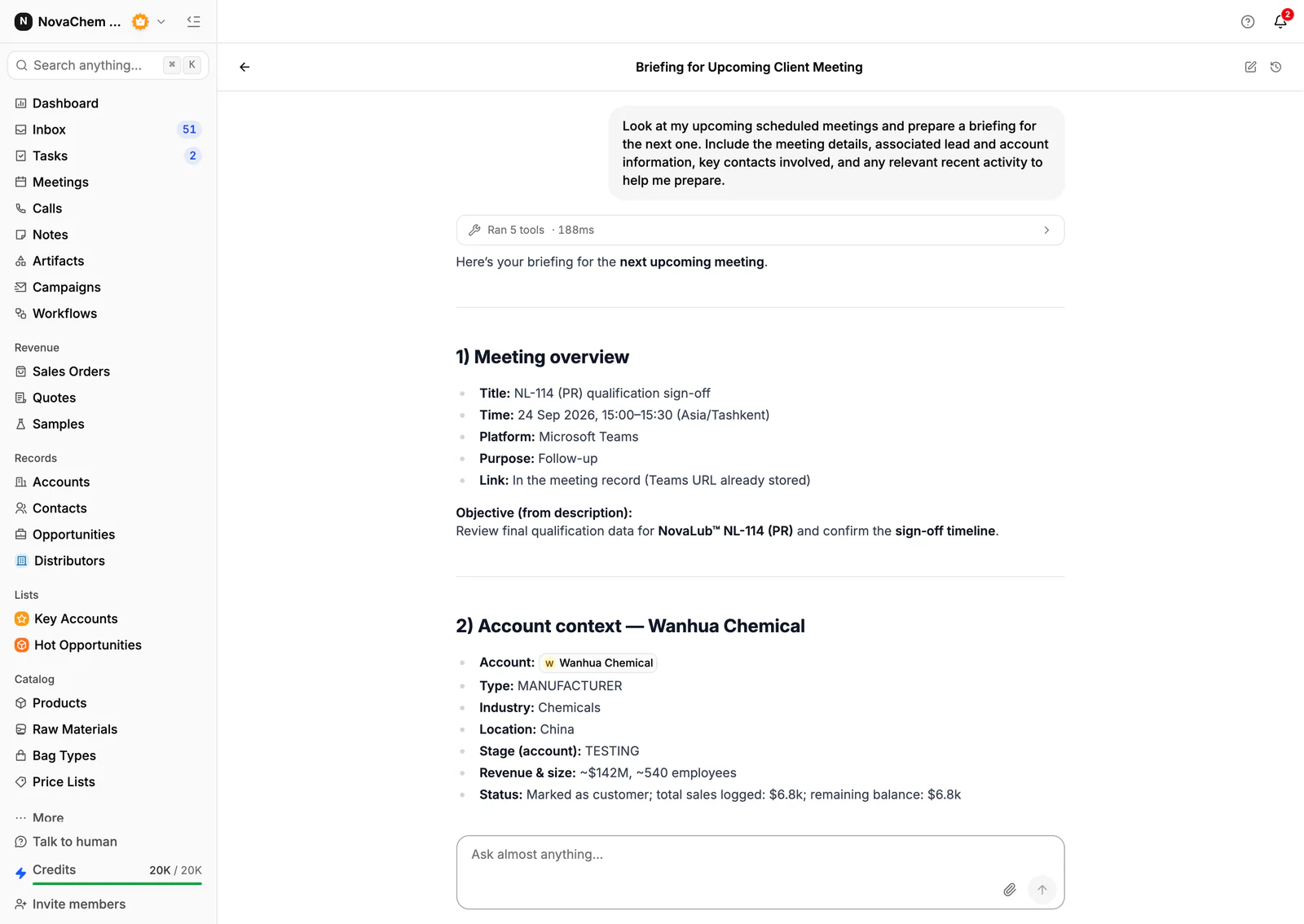
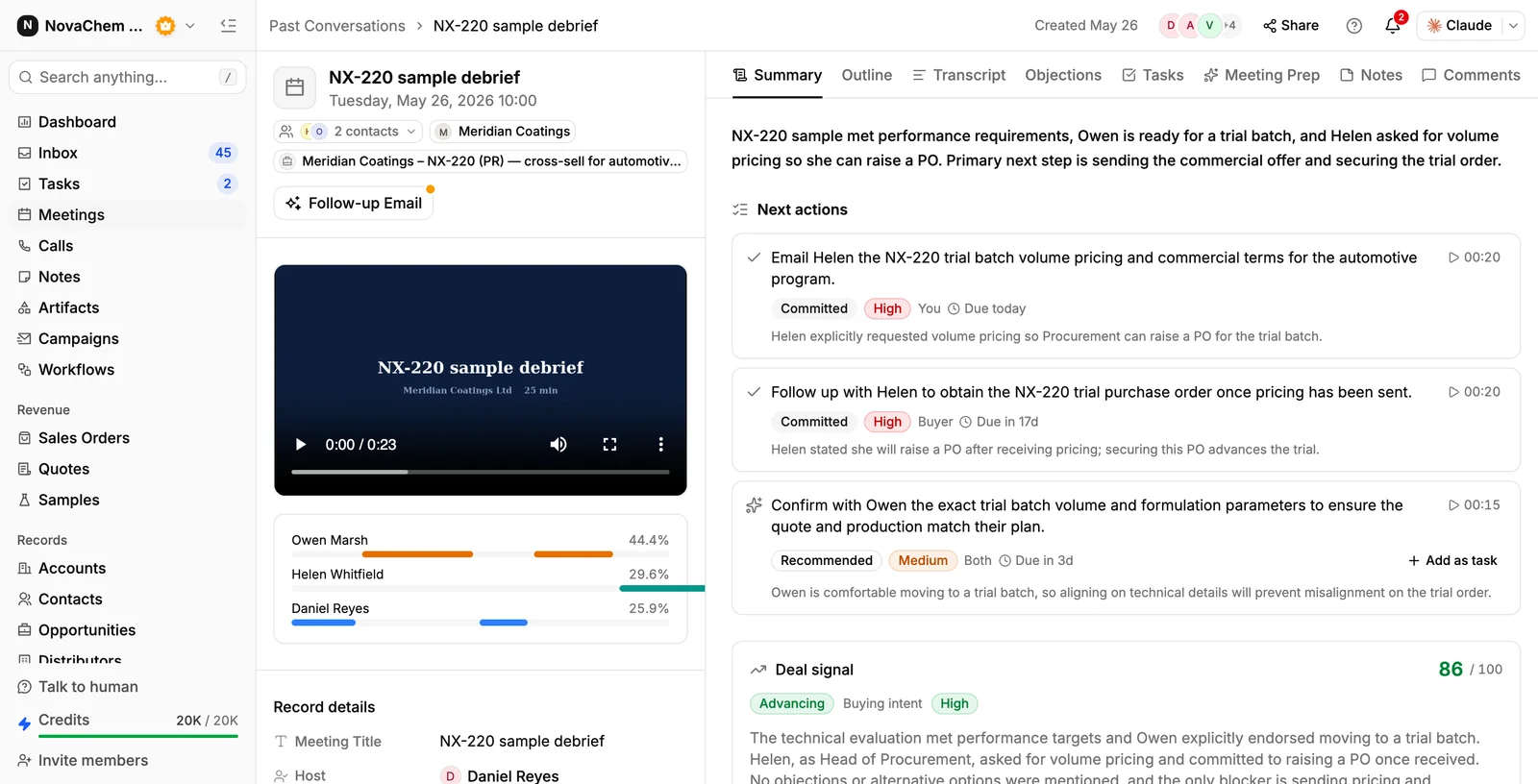
PromptLab records meetings in Google Meet, Zoom and Microsoft Teams, with transcripts in 30+ languages, and writes an AI summary and a follow-up email draft. Action items become CRM tasks, assigned to the rep and linked to the account, deal and contacts. Before the call, an AI pre-meeting brief on the meeting's Prep tab pulls together the account, contacts and history. Deals have expected volume and estimated value built in, and custom fields such as application keep the rest of the answers in a form you can filter.
Frequently asked questions
How long should a discovery call be?
Twenty to thirty minutes is enough for most B2B product sales. Longer is fine for technical buyers, but agree the time at the start and keep to it.
What questions should I ask on a discovery call?
Ask about the application, current product and supplier, volume, specification, decision makers, timing and the trigger. Ask open questions and listen more than you talk.
What is the difference between a discovery call and a sales call?
A discovery call is first and is about learning. A sales call comes later and presents a proposal built on what you learned. Mixing them early makes you pitch to a need you do not understand.
What should happen at the end of a discovery call?
A clear next step with a date, such as a sample, a quote or a technical call, and a short email repeating what was agreed. No next step usually means no deal.
Should I record a discovery call?
Yes, if the buyer agrees. Recording lets you listen instead of typing and gives you a summary to share. Tell them at the start.