



















How to write a sales email sequence
Write a B2B sales email sequence in five steps: pick one audience, plan four to six emails, give each a job, set the gaps, and stop it when the buyer replies.
 By the PromptLab team6 November 20265 min read
To write a sales email sequence, pick one audience and one goal, plan four to six emails that each have a different job, space them a few days apart, keep each one short with a single question, and stop the sequence as soon as the person replies or the email bounces. The first email opens the conversation, the later ones add a reason to reply, and the last one makes it easy to say no.
This guide is for sales reps and marketers at manufacturers and distributors who reach new buyers by email. If the term is new, read what an email sequence is first. This post is about writing one.
What makes a sequence work
A sequence is a short series of emails sent automatically to one person until they answer. It works when each email gives the reader something new: a different angle, a useful fact, an easier question. It fails when it is the same email resent with "bumping this to the top of your inbox".
Three rules cover most of it. Write to one kind of buyer, such as plastics converters who buy PP granules. Ask for one thing per email. Make every message short enough to read on a phone.
Step by step: write the sequence
- 1
Choose one audience and one goal
"Distributors in Poland who stock industrial adhesives" is an audience. "Book a 15-minute call" or "send a sample" is a goal. If you can't say both in one sentence, the emails will be vague. A different audience needs its own sequence. See how to build an ideal customer profile.
- 2
Plan four to six emails, each with a job
A simple plan: email 1 names a problem and asks a question; email 2 adds a proof point such as a data sheet or a result; email 3 offers a sample or a short call; email 4 shares a different angle, such as a price or lead-time advantage; email 5 asks for a clear yes or no. More than six is rarely worth it.
- 3
Write the first email for one reader
Open with why you are writing to them, not about your company. Name something specific: their product line, a trade show, a market change. Ask one question they can answer in a line. Keep it under 120 words. Our cold email templates for manufacturers have examples.
- 4
Write the follow-ups so each stands alone
The reader may not have opened the first email. Each follow-up should make sense by itself and bring something new. Don't write "as I mentioned". Reuse the thread only if it helps.
- 5
Set the gaps and the sending window
Send follow-ups two to four working days apart, and widen the gap later in the sequence. Send during the buyer's working hours, on weekdays. Random gaps of a few minutes between sends look more natural than a burst.
- 6
Write subject lines that read like a person wrote them
Short, lowercase-friendly and specific: "Question about your PP supply" beats "Exclusive offer inside". Test two versions against each other. See how to write sales email subject lines.
- 7
Stop on reply, include an opt-out and check the numbers
A buyer who replies must leave the sequence immediately, or you will email them after they said yes. Include a clear way to unsubscribe. After the first batch, read the replies, not just the opens. Change the weakest email and send again.
A five-email outline
| Day | Job | Example ask | |
|---|---|---|---|
| 1 | 1 | Open with a relevant problem | "Who handles supply of [product] at your site?" |
| 2 | 3 | Add proof | "Here's the data sheet and a typical result." |
| 3 | 7 | Offer a sample or call | "Want a 1 kg sample to test?" |
| 4 | 12 | A different angle | "Our lead time is [x] days from stock in [place]." |
| 5 | 18 | A polite close | "Should I close your file for now?" |
Subject: Question about your [product] supply
Hi [First name],

I'm writing because [Company] buys [product type], and we supply [short description] to [similar customers] in [region].

Who handles supply of [product type] at your site?

If it's not you, a name would help.

[Your name]
[Company]
Keep your list and your sending clean
A good sequence to a bad list still fails. Use accurate addresses, remove bounces, and send from mailboxes that have been warmed up. How to warm up a new sales mailbox covers that, and the cold email deliverability checklist covers the checks before you press send.
A worked example
Say a coatings manufacturer wants to reach independent paint distributors. The goal is a sample request. Email 1 asks who buys industrial primers. Email 2 attaches the data sheet for one primer. Email 3 offers a free 1 kg sample. Email 4 points out that the product ships from a local warehouse. Email 5 asks whether to close the file. Every email is under 100 words and asks one thing. When a distributor replies at email 2, the sequence stops and the rep takes over by hand.
How PromptLab helps
PromptLab email campaigns are multi-step sequences of up to 10 steps, sent from your own mailboxes. A campaign can rotate up to 20 mailboxes, supports A/B variants, and has a sending window and random gaps between sends. Each mailbox has a daily limit, and new mailboxes follow a three-week volume ramp-up. Open and click tracking are optional, every email has a one-click unsubscribe, and the sequence stops when the contact replies or the email bounces.
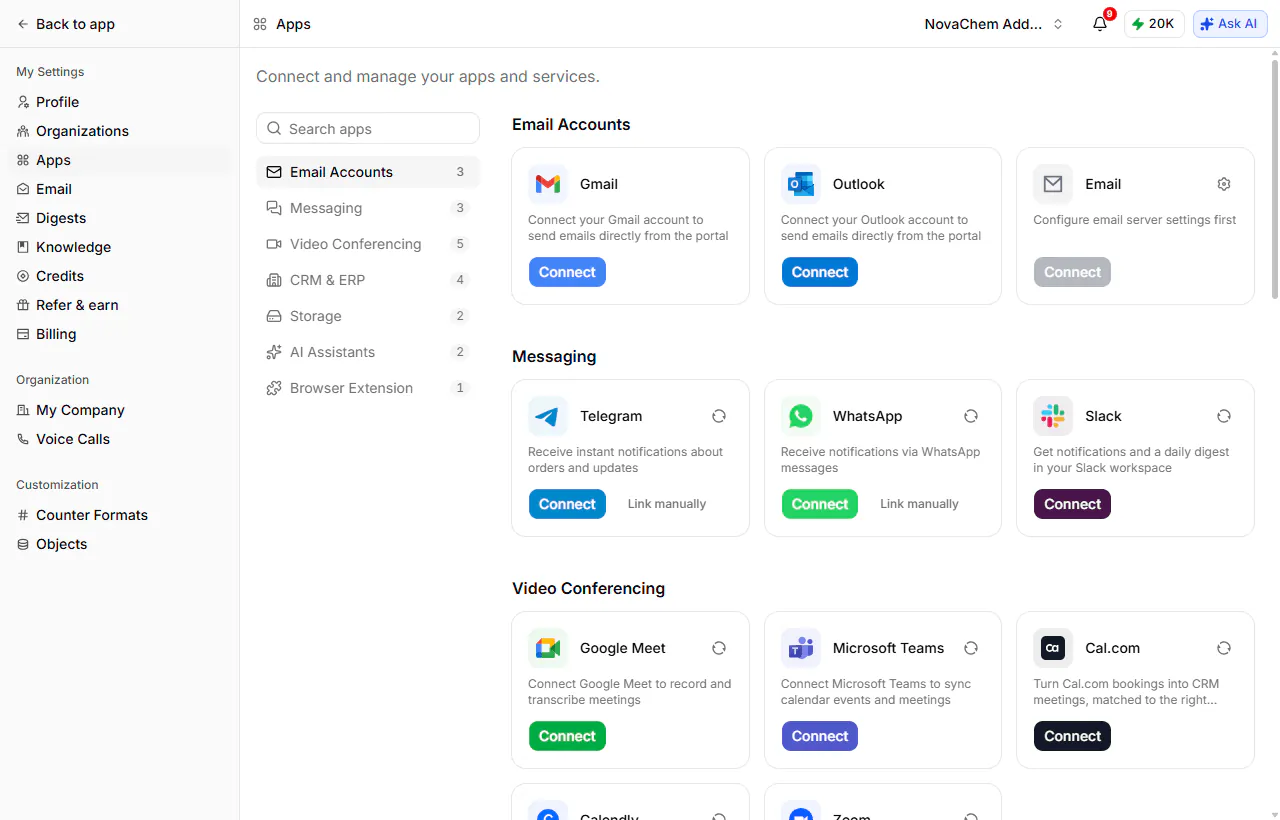
Replies land in the shared Inbox beside WhatsApp and Telegram, on the contact's record. A web form can add a new enquirer to a campaign, and website visitors can show you which pages a contact read after your email. See how to run an email campaign to distributors.
Frequently asked questions
How many emails should a sales sequence have?
Four to six emails is enough for most B2B outreach. The first few get most of the replies, and a long tail of reminders starts to irritate people.
How long should the gaps between emails be?
Two to four working days early on, widening to a week toward the end. Avoid sending on weekends unless your buyers work them.
What is the difference between a sequence and a campaign?
A sequence is the series of emails one person receives. A campaign is the whole send: a list of people, the sequence they get and the mailboxes used. In PromptLab a campaign holds a multi-step sequence.
Should I use open tracking?
It is optional. Opens are an unreliable signal, because mail apps can load images automatically, and tracking can affect deliverability. Replies and booked calls are better measures.
Should I personalise every email?
Personalise the opening line and the reason you are writing, using something real about the company. Keep the rest short and consistent so you can send to a whole segment.