



















What is a sales opportunity?
A sales opportunity is a qualified chance to win a specific sale from a specific buyer. Here is how it differs from a lead and how teams track one.
 By the PromptLab team29 October 20263 min read
Definition
Sales opportunity
A sales opportunity is a qualified prospect with a real chance of buying, tracked as a single potential sale with an expected value, a stage and an owner. It is also called a deal.
Not every enquiry deserves a place in the pipeline. An opportunity is the moment a lead has been checked and judged worth working: there is a buyer, a need and a plausible order.
Opportunity vs lead
A lead is a person or company that might buy. You have not checked whether they have a need, a budget or the authority to decide.
An opportunity exists once that check is done. It describes one potential sale, not a person. One account can have several opportunities at once, say a trial order of one product and a larger annual supply of another.
Teams often call the check "qualification". See how to qualify B2B leads for the questions to ask.
What an opportunity records
- The account and contact: who is buying and who you talk to.
- The product or scope: what they want to buy.
- The expected value: the order size you hope to win.
- The stage: which of your deal stages it has reached.
- The owner: the rep responsible.
- The next step: the task or meeting that moves it on.
Without a next step, an opportunity is only a hope. The most useful habit is to never leave one without a dated task.
How it moves through the pipeline
Stages vary by company. For a team that sells products, a typical path is: qualified, sample sent, quote sent, negotiation, won or lost. At each stage the rep updates the record, and the pipeline shows how many opportunities sit in each one.
When an opportunity closes as lost, record why. A short list of reasons, such as price, timing or product fit, turns lost deals into something you can learn from. See how to analyse lost deals.
An example from product sales
Say a packaging supplier gets an enquiry from a food producer. A rep calls and learns that the producer needs 50,000 cartons by spring and is comparing two suppliers. That is now an opportunity, worth about $14,000, at the "qualified" stage.
The rep sends samples, which moves it to "sample sent", and books a follow-up task for the week after delivery. Later a quote moves it on again. If the producer picks the other supplier, the rep closes it as lost with the reason "Price".
Related terms
- Deal stage: the step an opportunity has reached.
- Sales pipeline: all opportunities, grouped by stage.
- Sales cycle: how long an opportunity takes from start to close.
- Win rate: the share of opportunities you win.
How PromptLab handles it
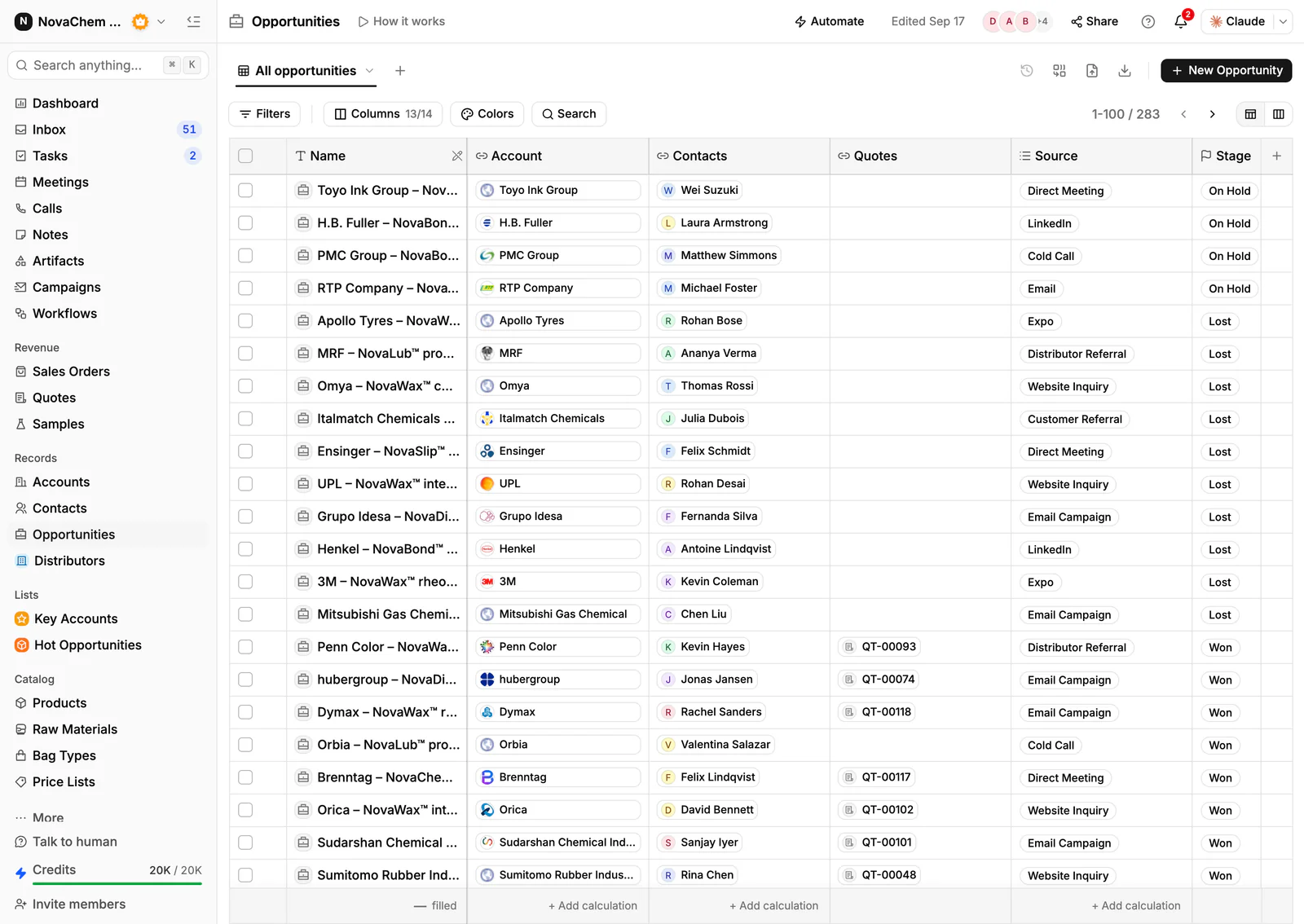
PromptLab has opportunities alongside accounts and contacts, with one deal pipeline per workspace. Each opportunity has a stage, an owner and tasks. Lost deals need a loss reason from a fixed list: Price, Competitor, Timing, No budget, Product fit or Other. Quotes, sales orders and sample tracking hang off the same account.
Frequently asked questions
What is the difference between a lead and a sales opportunity?
A lead is an unchecked prospect. An opportunity is a lead that has been qualified and is being worked as a specific potential sale, with a value, a stage and an owner.
Is a sales opportunity the same as a deal?
In most CRMs, yes. The two words are used for the same record, though some teams say "opportunity" before a quote and "deal" after.
When does a lead become an opportunity?
When you have confirmed a real need, a likely budget and a route to a decision. The exact rule is your own, but write it down so every rep applies it the same way.
Can one account have several opportunities?
Yes. Each potential sale is its own opportunity, so a customer can have one for a trial order and another for a yearly contract at the same time.
How many opportunities should a rep manage?
There is no fixed number. It depends on your sales cycle and deal size. A good test is whether every opportunity has a next step with a date.