



















CRM for insulation materials suppliers
How insulation suppliers sell mineral wool, PIR boards and EPS to contractors and merchants, from take-offs and tenders to site deliveries, and a CRM setup.
 By the PromptLab team7 November 20266 min read
An insulation materials supplier sells mineral wool, glass wool, PIR and PUR boards, EPS and XPS, pipe insulation and the accessories that go with them to insulation contractors, builders and merchants. The product is bulky and light, so freight is a large part of the cost, and the order is usually tied to a building programme. A CRM for this trade has to track projects, quantities and delivery dates, not only contacts.
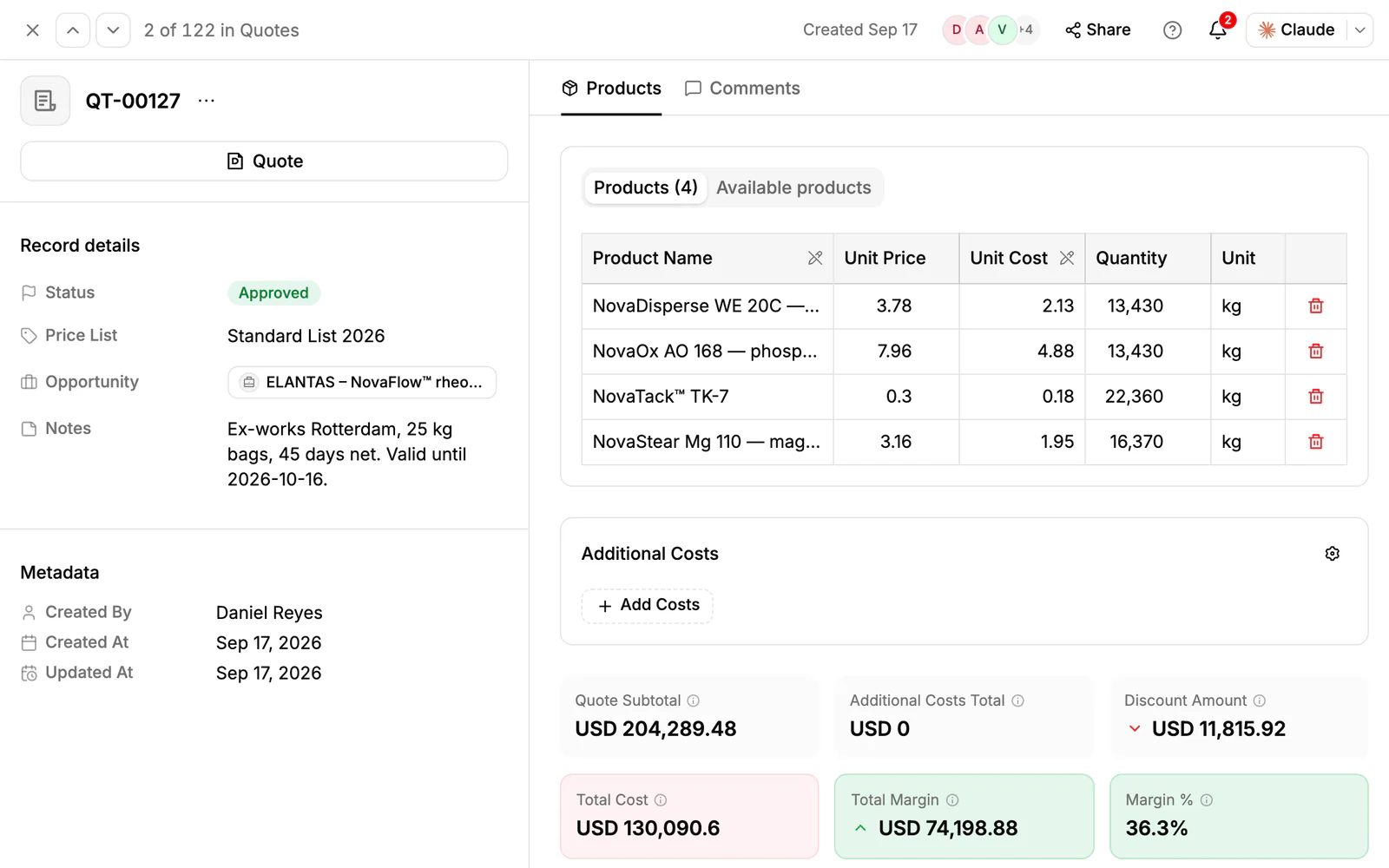
In PromptLab, project quotes use a customer price list and named delivery costs, a product sample goes on the deal, and each order is a sales order on the account with trade terms and a planned delivery date. The wider view is on the distributors page.
How does an insulation supplier actually sell?
Insulation contractors work from a drawing and a specification. They want the right product at the right thickness on site on the day the crew arrives. A late delivery idles labour.
Builders and main contractors buy for a project and negotiate on the whole package. They rely on their contractor for the technical side.
Builders' merchants and distributors hold stock and resell. They care about pallet price, stock availability, margin and whether you support them on a hard job.
Specifiers, such as architects and engineers, rarely buy but decide which products are allowed. Getting named in a specification wins sales for months.
Seasonality follows the building calendar, so check your own order history for the pattern rather than assuming one.
What do buyers ask before they order?
- Performance data. Thermal conductivity, the fire classification and compressive strength for the product at hand. Keep the data sheet current on the account.
- Thickness and size. The U-value target drives the thickness. The buyer works out the area from the drawings (the take-off) and asks you to price it.
- Compliance. Declarations of performance and any test reports the project requires. Attach the ones you sent to the account's Files tab.
- Pallets, not pieces. Price is quoted per square metre or per pallet, and minimum order is often a pallet or a truck load. What is MOQ is a short refresher.
- Delivery to site. Date, access, unloading and whether the load needs a crane or a forklift. A wrong access note costs a day.
- Alternatives. If the specified brand is out of stock, can an equal product be used? The specifier or the contractor's engineer decides. Record who approved it.
- Credit. Merchants and larger contractors buy on terms. What is a credit limit explains how to set one.
How do samples and tenders fit?
Samples matter less than in chemicals, but a board or a roll sample, or a printed data pack, helps an installer or a specifier decide. Log each as a sample on the deal. PromptLab has sample tracking on every plan, with samples on the deal.
Tenders are more important. A main contractor sends a bill of quantities to three suppliers, and the lowest correct price often wins. How to manage tenders and bids and the tender submission checklist cover the routine, and how to respond to an RFQ fits a contractor's price request.
How should you quote a project?
Build the quote from products and a customer price list, with line discounts where you give them. A quote can carry named additional costs such as delivery, added to the total. The quote has one Notes field, printed on the PDF: put the validity, the delivery assumptions and the stock position there, because quote lines have no notes of their own and there is no expiry field.
Contractors, merchants and large builders usually need different prices. A customer price list adds a set amount on top of each product's base price, so it cannot go below base, and editing a list reprices only its Draft quotes. Lines priced by hand keep their price. What is a customer price list explains the mechanics.
What pipeline stages fit an insulation supplier?
PromptLab has one pipeline per workspace. Use a field to separate project, merchant and stock-order deals.
| Stage | Entry condition |
|---|---|
| Enquiry | A contractor or merchant asks for a price or a data sheet |
| Take-off priced | Quantities are confirmed and the product is chosen |
| Quote sent | A quote with delivery cost is out |
| Specification or alternatives | The product is approved, or a substitute is agreed |
| Approved | The buyer accepts price and programme |
| Order placed | A sales order exists on the account |
| Delivered | The load is on site and the account is back in reorder |
Add a custom date field for the delivery-by date, since deals have no built-in expected close date.
What must the CRM track?
- Projects per account, as deals, each with an estimated value and expected volume.
- Contractors and specifiers as contacts on their own firms' accounts, with the specifier who named your product recorded on the deal in a custom field.
- Price lists for contractors, merchants and projects.
- Documents on the account's Files tab: data sheets, declarations and test reports.
- Delivery details on the sales order: Incoterm, planned date and a note for site access. What is Incoterms lists the rules.
- Reorder rhythm for merchants, as a task dated for the next usual order.
- WhatsApp and Telegram messages from site managers, in the shared Inbox beside email.
How do you set this up in PromptLab?
- 1
Import accounts and products
Bring accounts, contacts and products in from CSV or Excel. Add product fields for thickness, material and fire class, so a rep finds the right board by what the buyer says.
- 2
Create price lists
Build one customer price list for contractors, one for merchants and one for large projects. Quote from them so the price is the same each time.
- 3
Quote the take-off
Create the quote from the list, add delivery as an additional cost, and note the validity. Send the PDF or the public link, and set a next follow-up date.
- 4
Raise the sales order
Create the order on the account, with trade terms and a planned delivery date. Raise the invoice from the sales order.
- 5
Chase tenders and quiet merchants
Put a dated task on every open tender and on every merchant's next usual order. Tasks do not repeat, so set the next one when you complete it. A daily digest in Slack, Telegram or WhatsApp lists tasks due.
- 6
Capture site messages
Connect your WhatsApp Business number and company Telegram bot so site managers can message first and the thread lands on the right contact.
How does PromptLab compare for insulation suppliers?
Swipe the table sideways to see every CRM →
| Checked on 30 September 2026 | PromptLab |  Zoho CRM |  Pipedrive |  HubSpot |
|---|---|---|---|---|
| Pricing | ||||
| Paid plans, a month | $11.99 – $99per seat | $14 – $52per seat | $14 – $79per seat | $7 – $150per seat |
| Number of plans | 3 | 4 | 4 | 4 |
| Free trial | ||||
| Billing | Billed monthly | Billed annually | Billed annually | Billed annually, plus a $1,500–$3,500 onboarding fee |
| Import from CSV and Excel | ||||
| Sales management | ||||
| Deal pipelines | ||||
| Quotes | From$23/month | From$59/month | Add-on | |
| Sales orders | From$23/month | |||
| Sample tracking | ||||
| Price lists | From$23/month | |||
| Meetings and calls | ||||
| Meeting recording and transcripts | Via marketplace | From$90/month | ||
| AI meeting summaries | ||||
| AI follow-up email drafts | From$23/month | From$59/month | From$90/month | |
| Meeting scheduler and call dialer | From$23.99/month | Via marketplace | From$39/month | |
| AI and automation | ||||
| CRM fields filled in from calls | From$40/month | From$90/month | ||
| Connect Claude or ChatGPT (MCP) | ||||
| Workflow automation | From$39/month | |||
| API and webhooks | From$23.99/month | |||
| Conversations | ||||
| Gmail and Outlook email sync | From$39/month | |||
| WhatsApp conversations | From$39/month | Add-on | ||
| Telegram conversations | ||||
| Save LinkedIn profiles | From$23/month | Via marketplace | From$150/month | |
| Privacy and security | ||||
| Single sign-on (SSO) | From$99/month | From$40/month | From$150/month |
Zoho CRM is the value pick among the big generalists, free for three users and paid from $14 a user a month billed annually. Quotes, orders and price books start at $23, and samples aren't modelled. Pipedrive is easy to learn, from $14 a seat billed annually, with no samples, price lists or sales orders, and quotes wait for Premium at $59.
HubSpot's Starter plan is $7 a seat a month, billed annually, but quoting sits in the separate Revenue Hub and sales orders and price lists aren't there. See Pipedrive vs PromptLab. Prices are as checked on 30 September 2026.
Frequently asked questions
What should a CRM for an insulation supplier include?
It should hold project deals, quotes with delivery costs, price lists for contractors and merchants, sales orders with delivery terms, data sheets on the account and every site message. PromptLab covers these from $11.99 per user per month.
How do I price different customers differently?
Use a customer price list for each group and pick it on the quote. A list adds a set amount on top of each product's base price.
Can the CRM add delivery to a quote?
Yes. A quote can carry named additional costs, such as delivery, which are added to its total.
How do I keep track of tenders?
Create a deal for each tender with a next follow-up date and a custom close-date field, and put the submission requirements in a task or note. The tender checklist covers what to include.
Is there a free trial?
Basic and Professional come with a 14-day free trial, with no card needed. There is no free plan.
Sources
Prices and features of other CRMs come from each vendor's own pages, on the dates below.
- Zoho CRM, checked on 30 September 2026: Pricing, Features, WhatsApp integration, MCP
- Pipedrive, checked on 30 September 2026: Pricing, MCP server, Nova, Exporting data
- HubSpot, checked on 30 September 2026: Sales Hub pricing, Revenue Hub quote software, WhatsApp integration, MCP servers, Single sign-on (SSO)