



















CRM for label manufacturers
How label manufacturers sell printed labels to food, drinks and cosmetics brands, from artwork proofs and tooling to repeat runs, and a CRM setup for it.
 By the PromptLab team7 November 20266 min read
A label manufacturer prints self-adhesive labels, sleeves and wraps for brands in food, drinks, cosmetics, chemicals and logistics. The first order is slow: artwork, a proof, a die and a press trial. The repeat order is fast and often the same job, which is where the money is. A CRM for this trade has to remember every job's specification, because a reorder that needs the buyer to explain the label again is a reorder at risk.
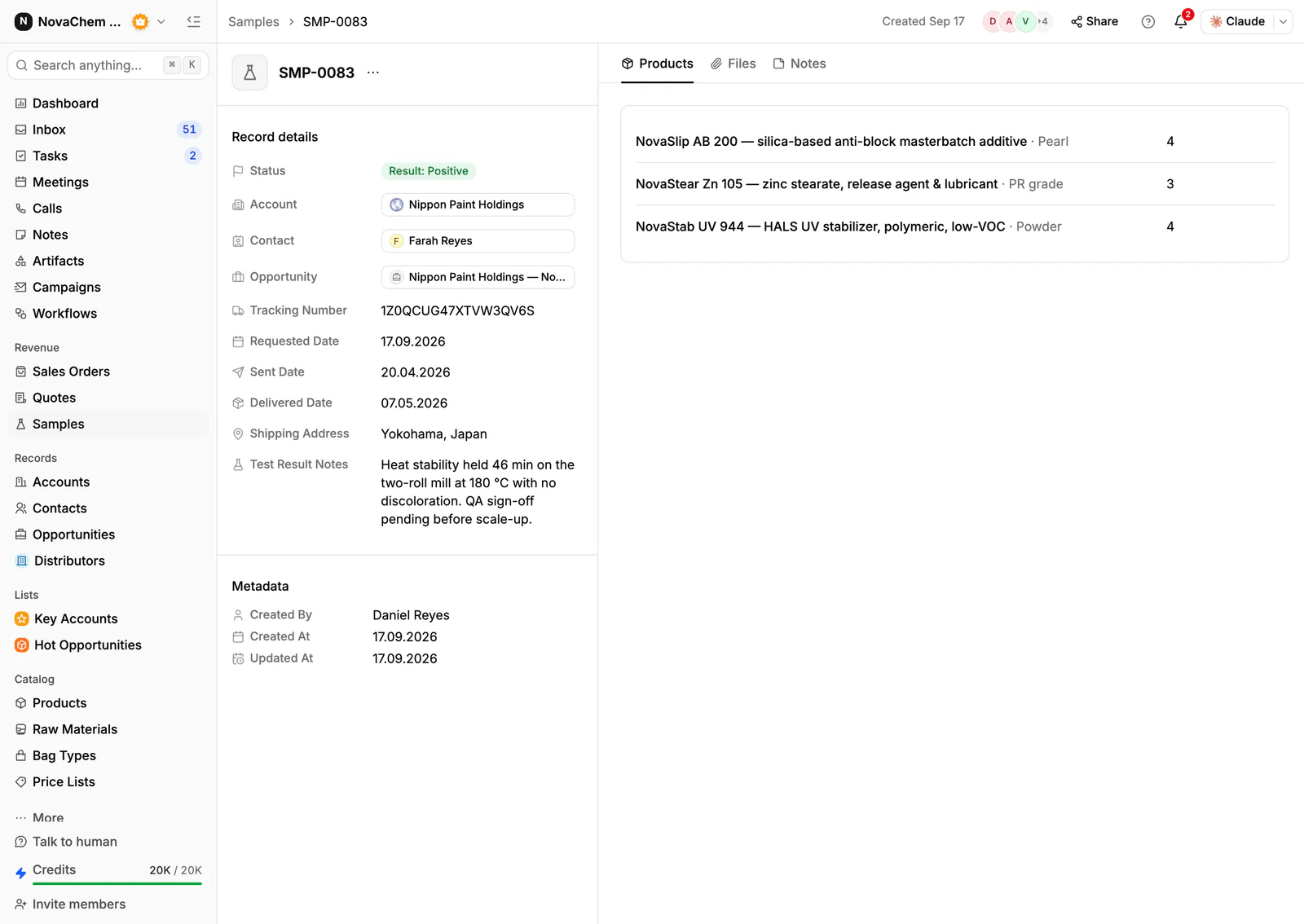
In PromptLab, a proof or a press trial is tracked as a sample on the deal, each brand gets a price list, and every run is a sales order on the account. The wider view is on the manufacturers page.
How does a label manufacturer actually sell?
Brand owners such as food and drink producers, cosmetic companies and chemical blenders buy labels to put on their product. The buyer is a procurement or packaging manager, but marketing owns the artwork and quality owns the compliance.
Contract packers and bottlers buy labels on behalf of several brands. They need delivery to the line on a day and care about roll size, core and unwind direction as much as the design.
Distributors and converters buy plain or printed stock to resell or finish. They buy on price per thousand and on lead time.
A new job needs several approvals, and each can stall it. Print is a repeat business: once the label is approved, a brand buys the same job again and again until it is redesigned.
What do buyers ask before they order?
- The specification. Size and shape, material (paper, film), adhesive, finish, number of colours, roll direction and core size. Keep these as custom fields on the product, so the job is fully described once.
- Artwork and a proof. The brand sends artwork, you return a proof, and they approve it. Colour matching to a brand colour is often the sticking point.
- A press trial or sample run. Especially for hard surfaces such as wet bottles, curved packs or freezer use, the buyer needs to see the adhesive work.
- Tooling. A new shape needs a die. Say whether it is charged or included, and who owns it.
- Price per thousand and run lengths. Buyers often ask for breaks such as 5,000, 10,000 and 50,000 labels. Quote the tiers they ask for.
- Minimum order and lead time. Print runs have a minimum, and lead time runs from approved proof to delivery. What is MOQ and what is lead time explain both.
- Compliance. Food contact, allergen and barcode requirements. The brand owns the content, but you hold the sign-off evidence.
How does a proof work as a sample?
A proof is a label sample with a decision attached. It goes out, a person approves or rejects it, and the job cannot start until it is approved. A press trial on the real pack is the same thing, only slower.
PromptLab has sample tracking on every plan, with samples on the deal. Create a sample for every proof or trial, with custom fields for the artwork version and the approver, and a follow-up date on the deal. A workflow can create a task when a sample changes status, so a proof marked with a positive result sets off the next step. How to track product samples and how to turn samples into orders cover the routine.
How should you quote a label job?
A label quote is a price per thousand for each run length, plus tooling and delivery. Build the quote from the product and the brand's price list. Put each run-length break as its own line, and add tooling and delivery as named additional costs. The specification and the proof reference go in the quote's Notes field, which prints on the PDF, because quote lines have no notes of their own.
Quotes have statuses Draft, Pending and Approved, with no expiry date and no e-signature. What is a sales quote is a short refresher.
What pipeline stages fit a label manufacturer?
PromptLab has one pipeline per workspace. Use stages for new jobs and tag repeat orders with a field, then a saved view for each.
| Stage | Entry condition |
|---|---|
| Enquiry | A brand sends a specification or an existing label |
| Spec confirmed | Size, material, adhesive and quantity are agreed |
| Quote sent | Prices per run length, tooling and delivery are quoted |
| Proof out | Artwork proof or press trial is with the buyer |
| Proof approved | The buyer signs off the artwork |
| Order placed | A sales order exists on the account |
| Repeat cycle | The job is reordered on a rhythm |
What must the CRM track?
- Every live job per brand as a product with its specification fields, so a reorder starts from the last order.
- Proofs and trials as samples on the deal.
- Price lists per brand, with each run length quoted as its own line.
- Reorder rhythm. A task on the account, dated for when the brand normally reorders, catches a late order before the line runs out of labels.
- Documents on the account's Files tab: approved proofs, colour standards and compliance sign-offs.
- Messages. Packaging managers send files and questions by email and WhatsApp. The Inbox keeps them on the contact.
How do you set this up in PromptLab?
- 1
Describe each job as a product
Import products from CSV or Excel and add custom fields for size, material, adhesive, finish, colours and roll direction. A repeat order then starts from the product, not from memory.
- 2
Build a price list per brand
Create a customer price list for each key brand. A list adds a set amount on top of each product's base price, so it cannot sit below base. Editing a list reprices only its Draft quotes, so quotes already sent keep their price.
- 3
Log every proof as a sample
Create a sample on the deal for each proof, with the artwork version and approver. Set a workflow so a status change creates a task for the prepress or sales owner.
- 4
Quote, then create the order
Build the quote with a line per run length and tooling as an additional cost. When the PO arrives, create the sales order on the account, with trade terms and a planned delivery date.
- 5
Schedule the repeat
After delivery, create a task dated for the next expected order. Tasks do not repeat, so create the next one when you close it. The daily digest in Slack, Telegram or WhatsApp lists tasks due.
- 6
Review brands that went quiet
Ask AI which accounts have the oldest last order and call them. How to increase repeat orders has the routine.
How does PromptLab compare for label manufacturers?
Swipe the table sideways to see every CRM →
| Checked on 30 September 2026 | PromptLab |  monday CRM |  HubSpot |  Zoho CRM |
|---|---|---|---|---|
| Pricing | ||||
| Paid plans, a month | $11.99 – $99per seat | $12 – $28per seat | $7 – $150per seat | $14 – $52per seat |
| Number of plans | 3 | 4 | 4 | 4 |
| Free trial | ||||
| Billing | Billed monthly | Billed annually; Ultimate is custom-priced | Billed annually, plus a $1,500–$3,500 onboarding fee | Billed annually |
| Import from CSV and Excel | ||||
| Sales management | ||||
| Deal pipelines | ||||
| Quotes | Add-on | From$23/month | ||
| Sales orders | From$23/month | |||
| Sample tracking | ||||
| Price lists | From$23/month | |||
| Meetings and calls | ||||
| Meeting recording and transcripts | From$17/month | From$90/month | Via marketplace | |
| AI meeting summaries | From$17/month | |||
| AI follow-up email drafts | From$17/month | From$90/month | From$23/month | |
| Meeting scheduler and call dialer | From$23.99/month | From$17/month | Via marketplace | |
| AI and automation | ||||
| CRM fields filled in from calls | From$17/month | From$90/month | From$40/month | |
| Connect Claude or ChatGPT (MCP) | ||||
| Workflow automation | From$17/month | |||
| API and webhooks | From$23.99/month | From$17/month | ||
| Conversations | ||||
| Gmail and Outlook email sync | From$17/month | |||
| WhatsApp conversations | Add-on | |||
| Telegram conversations | ||||
| Save LinkedIn profiles | From$150/month | From$23/month | ||
| Privacy and security | ||||
| Single sign-on (SSO) | From$99/month | Enterprise plan | From$150/month | From$40/month |
monday CRM is the friendliest way to build a CRM from boards, with quotes and invoices from its $12 Basic plan, billed annually. Sales orders, samples and price lists aren't there. HubSpot has a free CRM and a Starter plan from $7 a seat a month, billed annually; quoting sits in the separate Revenue Hub and there are no price lists or sample tracking.
Zoho CRM has quotes, orders and price books from $23 a user a month, billed annually, and does not model samples. See monday CRM vs PromptLab. Prices are as checked on 30 September 2026.
Frequently asked questions
What should a CRM for a label manufacturer include?
It should hold the specification of each job, proofs and trials, a price list per brand, quotes with a line per run length, sales orders and a reminder for each brand's next repeat order. PromptLab covers these from $11.99 per user per month.
How do I track an artwork proof?
Log it as a sample on the deal, with the artwork version and approver in custom fields. Set a follow-up date, and a workflow can create a task when the status changes.
Can the CRM quote different run lengths?
Yes. Add a quote line for each run length from the product and the brand's price list, and add tooling and delivery as named additional costs.
How do I stop repeat orders slipping?
Put a task on the account dated for the brand's usual reorder. Tasks do not repeat, so set the next one when you complete it.
Is there a free trial?
Basic and Professional come with a 14-day free trial, with no card needed. There is no free plan.
Sources
Prices and features of other CRMs come from each vendor's own pages, on the dates below.
- monday CRM, checked on 30 September 2026: Pricing, CRM overview, monday.com for Enterprise
- HubSpot, checked on 30 September 2026: Sales Hub pricing, Revenue Hub quote software, WhatsApp integration, MCP servers, Single sign-on (SSO)
- Zoho CRM, checked on 30 September 2026: Pricing, Features, WhatsApp integration, MCP