



















How to handle sales objections
How to handle B2B sales objections other than price: listen, find the real concern, answer it with evidence, and agree the next step. Six common ones covered.
 By the PromptLab team7 November 20265 min read
To handle a sales objection, let the buyer finish, ask one question to find the real concern, answer it with evidence rather than argument, and agree the next step before you hang up. An objection is usually a request for information or reassurance, not a refusal. The buyer who raises one is still talking to you.
This guide covers every common objection except price, which has its own post: how to handle price objections. For ready-made wording, use the sales objection handling scripts.
What an objection really is
Buyers object for four reasons, and the answer differs for each:
- They need information. "Is this compatible with our line?" is a question dressed as a no.
- They fear risk. Changing supplier can cost them a production stop, and they would rather stay safe.
- They have a better alternative, or think they do. Often the incumbent supplier.
- It is a polite no. Sometimes the answer really is no, and you should find out quickly.
Telling these apart is the skill. The method below does it.
Step by step: the five-move response
- 1
Listen to the end
Don't interrupt, and don't start answering in your head. Let the buyer finish, then pause for a second. People often add the real point in the last sentence.
- 2
Acknowledge it
"That's fair, a change of supplier is a risk for you." One sentence is enough. You are not agreeing the buyer is right, only that you heard.
- 3
Ask one question to find the real concern
"What worries you most about switching?" or "What would need to be true for this to work?" The first thing a buyer says is often a cover for a smaller, more fixable worry.
- 4
Answer with evidence
Use a data sheet, a sample, a test result, a reference visit or a delivery record. Evidence beats persuasion. If you don't know, say so and promise an answer by a date.
- 5
Check and agree the next step
"Does that answer it?" Then name what happens next: "I'll send the sample on Wednesday and call you on Friday." An objection handled without a next step has not been handled.
Six common objections and how to answer them
"We already have a supplier"
Don't attack the incumbent. Ask what works well and what doesn't, and offer to be a second source: "Many buyers like a second supplier for security of supply. Could we quote a smaller volume as a backup?" A trial order is a smaller ask than a switch.
"Send me some information"
This is often a polite brush-off. Send something short and relevant, but ask first: "What would you want to see in it?" and book the call before you send it.
"Now is not a good time"
Ask when would be, and what is changing. "Is it a budget cycle, a project, or a contract that ends?" Then set a dated follow-up. See how to reactivate dormant accounts for the long game.
"I need to talk to my boss" or "It's not my decision"
Ask who else decides and offer to help your contact present: "Would a one-page summary help you take this to them?" See how to find decision makers in a company.
"I'm not sure your product will work for us"
This is a product-fit concern, and a sample is the answer. Offer a trial batch, or a technical call with your specialist, and agree what a successful trial looks like before it starts. See how to turn samples into orders.
"Your lead time is too long" or "We need smaller quantities"
Check whether it is a real constraint. If the buyer needs it in two weeks and you ship in four, say so. If it is a minimum order issue, ask whether a smaller first order or a call-off schedule would help. Never promise a date you cannot meet.
Mistakes to avoid
- Arguing. If the buyer feels they lost the argument, they will not buy.
- Answering before understanding. The first objection is rarely the real one.
- Dropping the price. A non-price objection answered with a discount teaches the buyer that objections work.
- Promising what you cannot deliver. A quick yes to a lead-time demand becomes a late delivery and a lost account.
- Ignoring the silent no. If a buyer goes quiet after an objection, follow up with a direct question, not another pitch.
A worked example
Say you sell a coating additive and the buyer says, "We tried something similar and it didn't work." You ask, "What went wrong?" It turns out it clogged their filter. You pass the question to your technical team, who confirm your grade has a different particle size. You send the data sheet and offer a small sample run, with a test the buyer's lab defines. The buyer agrees to trial it. The objection led you to a real, fixable concern.
How PromptLab helps
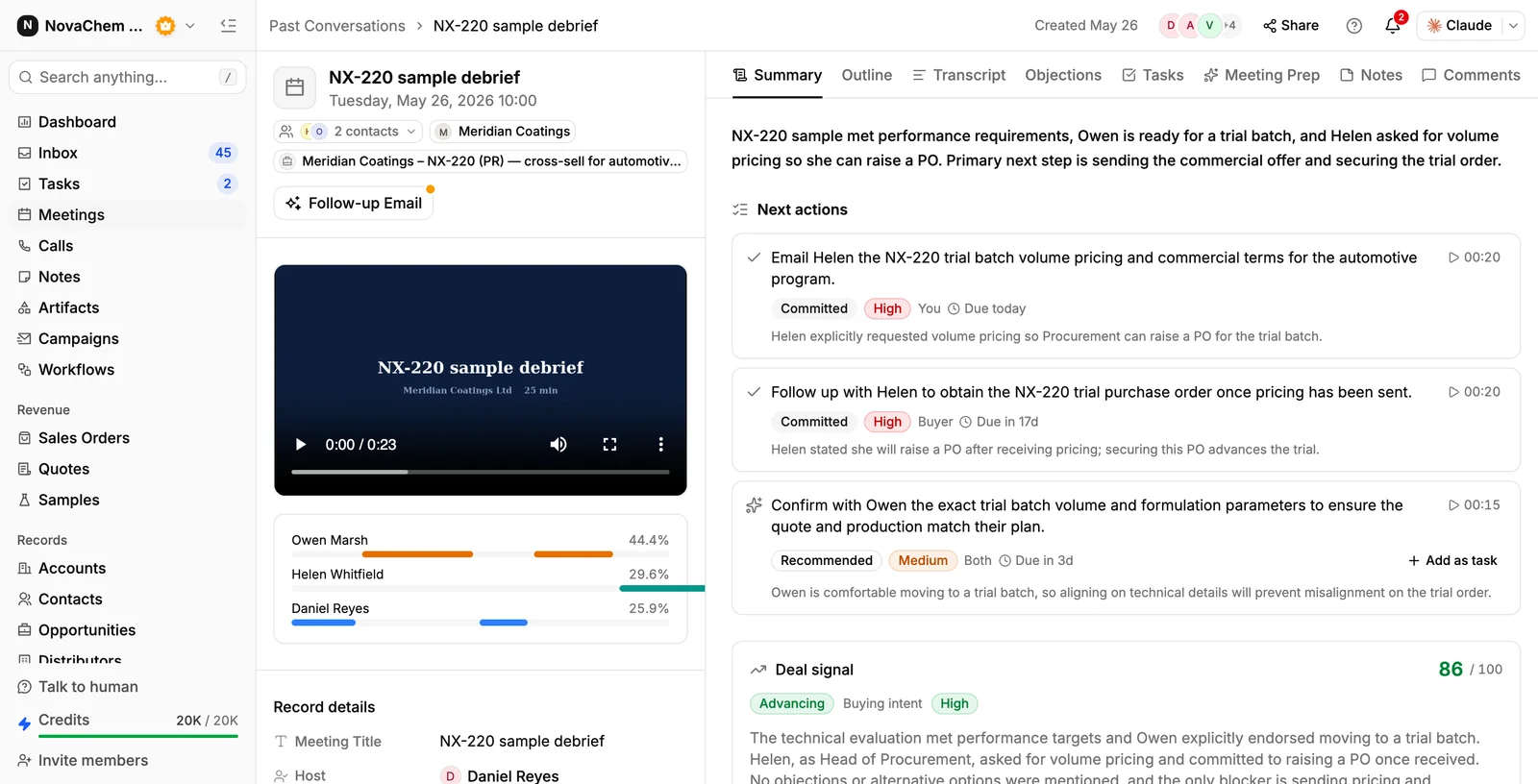
PromptLab records meetings in 30+ languages (Google Meet, Zoom, Microsoft Teams) with transcripts and AI summaries, so what the buyer actually said is on the deal rather than half-remembered. Each recorded meeting also has an Objections tab that lists the objections raised, tagged by type (pricing, timing, competitor, authority, need or risk) with who raised them. AI follow-up email drafts give you a first version of the answer to send, and action items become tasks, assigned to the meeting's creator with a due date when the transcript gives one. Sample requests link to the deal, which suits the "will it work for us" objection. If a deal is lost, PromptLab asks for a loss reason from a fixed list (Price, Competitor, Timing, No budget, Product fit, Other), so you can count which objections end deals.
Frequently asked questions
What are the most common sales objections in B2B?
Price, an existing supplier, timing, not being the decision maker, doubts about product fit and lead time or minimum order. This guide covers every one except price.
How do I know if an objection is real?
Ask a follow-up question: "What would need to be true for this to work?" A real objection gets a specific answer. A brush-off gets a vague one.
Should I answer an objection immediately?
Not before you understand it. Acknowledge it, ask one question, then answer. If you need information, promise an answer by a date.
What do I do when the buyer says no?
Ask what would change their mind and when to check back, then log the reason. A "no for now" with a date is a useful result.
How can I prepare for objections before a meeting?
List the three you expect, write a short answer and the evidence for each, and check your last notes on the account. A pre-meeting brief helps.