












What is account-based selling?
Account-based selling treats each target customer as a market of its own and sells to several people there. Learn how it works for B2B product sellers.
 By the PromptLab team6 October 20263 min read
Definition
Account-based selling
Account-based selling means choosing a short list of customers that matter most and working each one as a whole company, with several contacts and a plan, instead of chasing one lead at a time.
The question moves from "which lead should I call?" to "how do we win more business at this customer?"
Why account-based selling matters
In B2B product sales, one buyer rarely decides alone. A lab tests the product, a purchasing manager negotiates, a plant manager signs off. If you only know one of them, a deal can stall when that person leaves or changes role.
Large customers also buy repeatedly and across product lines. Selling to the account, not the contact, is how you grow that business.
How account-based selling works
- Pick your target accounts. Choose them by size, fit and chance of repeat orders. A list of 20 beats a list of 200.
- Map the people. Find the buyer, the technical tester, the budget holder and anyone who can block the deal.
- Plan the approach. Decide what each person cares about: spec, price, supply security.
- Coordinate the team. Sales, technical support and customer service speak with one voice.
- Review each account. Look at what was sold, what is open and what is next.
An example from a coatings manufacturer
This example is made up.
A coatings maker targets a furniture group that runs four factories. A rep has only ever sold to one factory's buyer. The account plan finds the group's technical director, a purchasing lead and three factory managers.
The rep arranges a meeting with the technical director, sends samples to a second factory and sends the purchasing lead a customer-specific price list. Within a year, three factories order instead of one.
Account-based selling and a lead-based approach
| Lead-based | Account-based | |
|---|---|---|
| Starting point | A single person | A company |
| Contacts | One or two | Several roles |
| Focus | Volume | Depth |
| Best for | Many small buyers | Fewer, larger customers |
Many teams use both: a lead-based approach for small buyers and an account plan for the biggest.
What you need in a CRM
- A record for each account that shows every contact and deal.
- A timeline of every email, call and message in one place.
- Quotes, samples and orders visible on the account.
- A way to spot accounts that have gone quiet.
Related terms
- A CRM is the home for account records.
- A shared inbox shows every conversation with the account.
- A customer price list keeps pricing consistent across sites.
- Lead scoring is the lead-based counterpart.
- A deal stage tracks each deal inside the account.
How PromptLab handles it
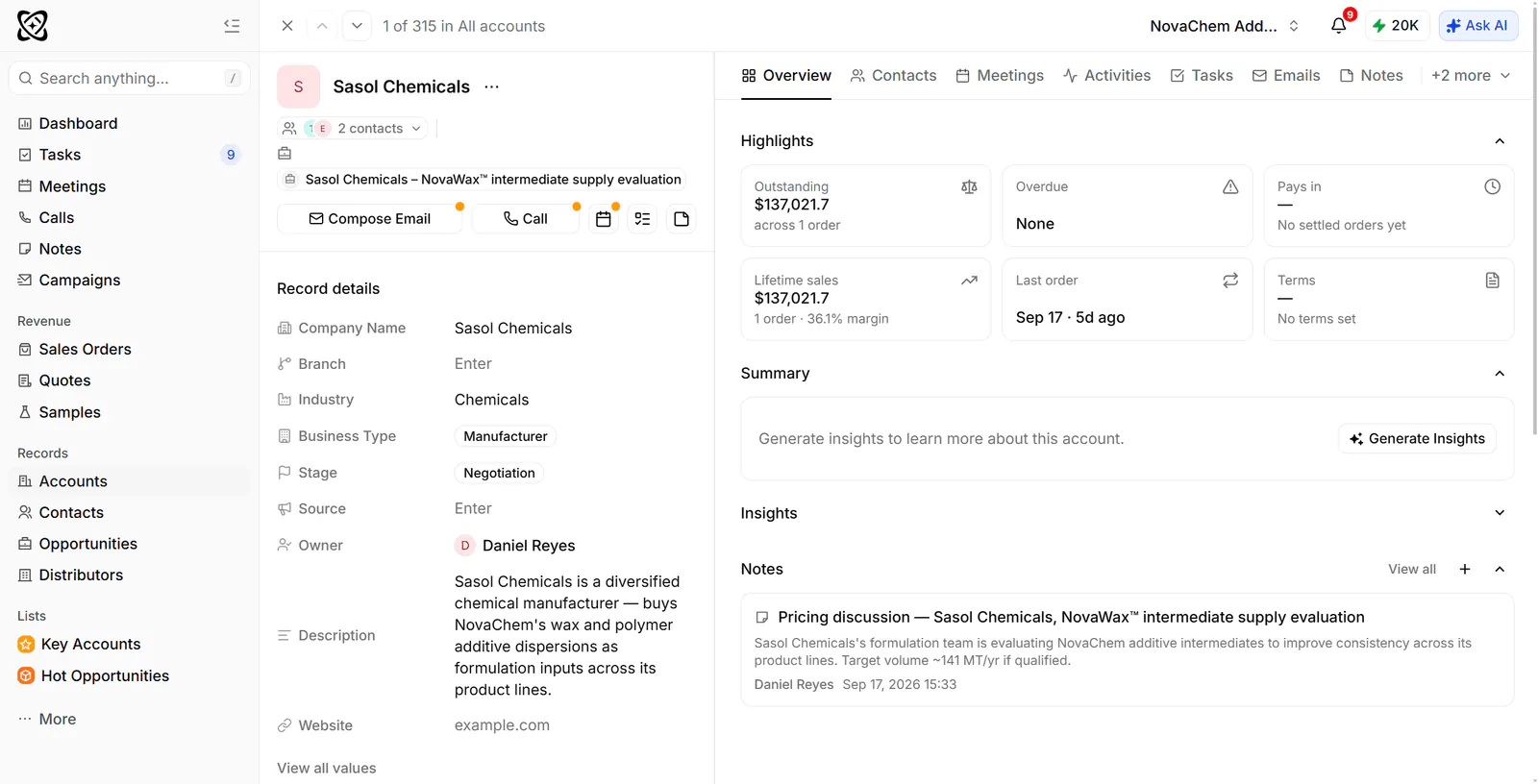
PromptLab is built around the account. An account record shows its deals, contacts and activity, and emails, WhatsApp and Telegram messages link to it through the shared Inbox. Quotes attach to the deal, and each sample record names the account it went to. PromptLab also flags accounts with no recent engagement, and Ask AI answers questions in plain words about accounts, deals and quotes.
Frequently asked questions
Is account-based selling the same as account-based marketing?
They are related. Account-based marketing aims marketing at chosen accounts. Account-based selling is the sales team's work on the same accounts.
How many accounts should I target?
Few enough to give each real attention. Many teams start with 10 to 30 and expand once the approach works.
Does it work for small teams?
Yes. A small team with a handful of large customers gains the most from knowing each account well.
Can I see all contacts at a customer in PromptLab?
Yes. The account record lists its contacts, deals and activity in one place.