



















How to follow up on a quote
Follow up on a B2B quote in four touches over two weeks: confirm receipt, answer questions, address the real objection, then ask for a clear yes or no.
 By the PromptLab team6 November 20265 min read
To follow up on a quote, confirm the same day that the buyer received it, call or write again after two or three working days with a specific question, address the likely objection in a third touch, and close with a polite request for a yes, a no or a new date. Set the next follow-up before you send the quote, not after it has gone quiet.
This guide is for sales reps and leaders at manufacturers and distributors, where a quote often sits with a buyer who is comparing suppliers. For ready-to-send wording, use quote follow-up email templates. This post covers the timing and the thinking behind it.
Why quotes go quiet
Silence after a quote rarely means no. More often the buyer is waiting on a colleague, comparing three prices, short of time, or unsure about something they haven't told you. The usual reasons are:
- The quote reached the wrong person, or only one of the people who decide.
- The price is higher than another supplier's, and the buyer doesn't know how to say so.
- Something is unclear: lead time, minimum order, payment terms or whether a sample was enough.
- The project slipped, so the order is not urgent any more.
Your follow-up has to find out which one it is.
Step by step: a four-touch follow-up
- 1
Before you send: agree the next step
When you send the quote, say what happens next. "I'll call on Thursday to go through it" gives you a reason to follow up, and the buyer an expectation. Put the date in your task list the same minute. See how to write a sales quote for the quote itself.
- 2
Touch 1, the same day: confirm it arrived
A two-line message: "I've sent the quote for [product]. Could you confirm it reached you, and is there anyone else who should see it?" This catches wrong addresses and finds the other decision makers early.
- 3
Touch 2, after two or three working days: ask a real question
Don't write "just checking in". Ask something that moves the deal: "Does the lead time work for your first production run?" or "Is there a volume where the price would work better?" A question gives them something easy to answer.
- 4
Touch 3, after about a week: name the likely objection
If you've heard nothing, say what you think might be in the way: "Some customers find the minimum order too high for a trial. We can quote a smaller first order if that helps." Offer one concrete option, not a discount by reflex. See how to handle price objections.
- 5
Touch 4, after about two weeks: ask for a clear answer
Be polite and direct: "I'd like to keep your file up to date. Should I hold this quote open, adjust it, or close it for now?" Buyers respond to a message that makes saying no easy. A "no for now" with a date is a useful result.
- 6
Close the loop in the CRM
If the answer is yes, move the deal on. If it is a no, record the reason. If it is "later", set a follow-up date for when they said. Never leave a quote hanging with no next step.
What to do with a quote that has expired or changed
Quotes age. Prices move, raw material costs shift and stock changes. If a quote has been out for weeks, issue a refreshed one rather than arguing about an old price. State clearly in your reply how long the price holds, and put the validity in the quote notes so the buyer can see it.
Common mistakes
- "Just checking in." It asks nothing and gives the buyer nothing to answer.
- Dropping the price at the first silence. You teach the buyer to wait.
- Following up only once. Most replies come after the second or third touch.
- Chasing the wrong person. Find out who signs off.
- Not recording the outcome. A lost reason is a free lesson. See how to analyse lost deals.
A worked example
Say you quote a packaging distributor 20 pallets of stretch film on Monday. You note "call Thursday" on the deal. On Monday you confirm receipt and find out the warehouse manager must approve it too. On Thursday you ask whether the lead time suits their next delivery slot. They say the price is close but a rival offered a shorter lead time. Now you know the real objection and can answer it, instead of cutting the price blind.
How PromptLab helps
In PromptLab a quote is built from your products and a customer price list, with line discounts, a PDF and a public link you can send. A quote has a status: Draft, Pending or Approved. Quotes sit on the deal, and deals have a next follow-up date built in, so the date you promised the buyer is on the record, not in your head. The quote has a Notes field that prints on the PDF, which is a good place to state how long the price holds. PromptLab quotes have no expiry field of their own.
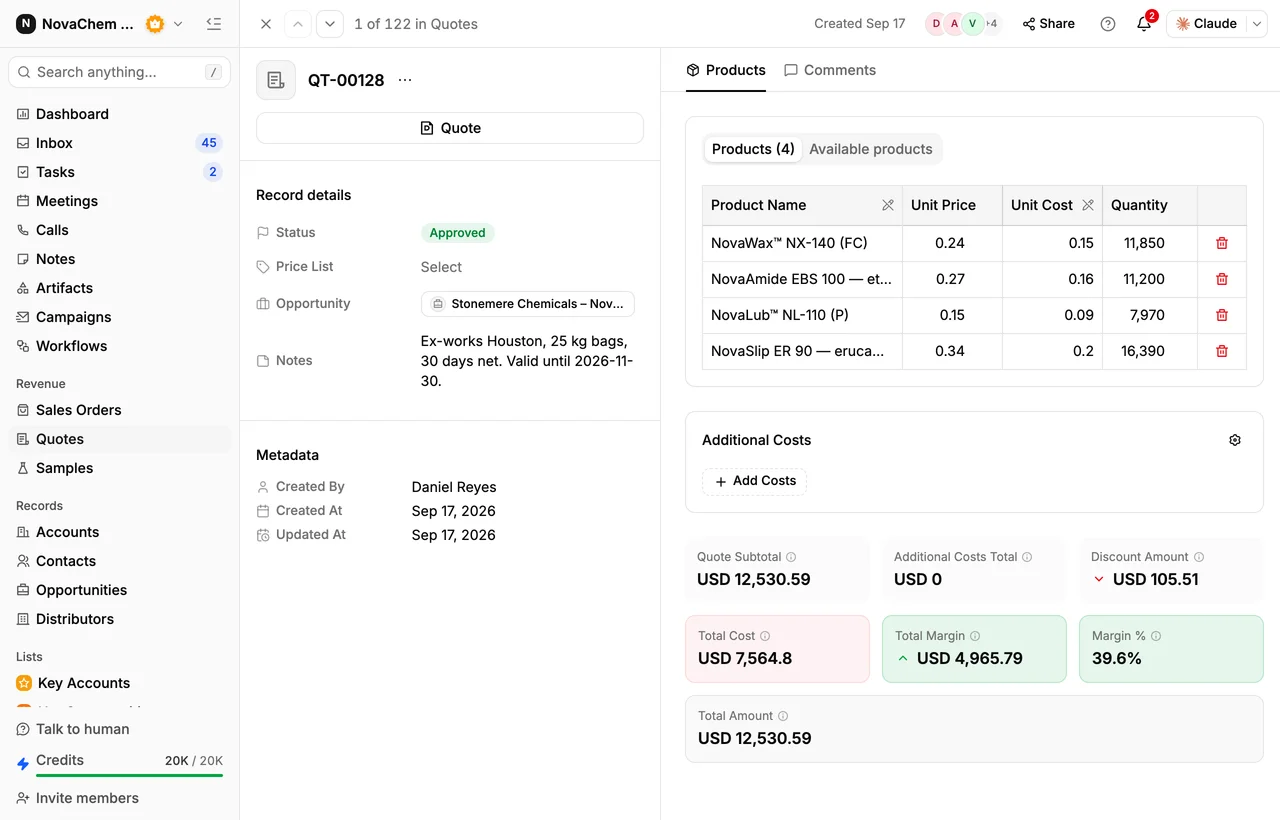
A workflow can create a task when a quote changes status, and when you reply to the buyer by email, WhatsApp or Telegram the conversation is on the same account. AI follow-up email drafts, generated from your meeting summaries, give you a first version to edit. See how to automate sales follow-ups. Note that approving a quote does not create a sales order: that is a separate record you create on the account.
Frequently asked questions
How long should I wait before following up on a quote?
Confirm receipt the same day, then follow up with a real question after two or three working days. If the buyer gave you a decision date, follow up the day after it passes.
How many times should I follow up on a quote?
Four touches over about two weeks is a sound pattern: confirm, ask, address the objection, then request a clear answer. After that, move the deal to a dated follow-up rather than chasing weekly.
What should I say if the buyer says my price is too high?
Ask what they are comparing it with, and whether the specification, volume and delivery terms are the same. Then offer options such as a different pack size or a volume break before cutting the price.
Should I follow up by phone or email?
Both. Email leaves a record the buyer can forward, and a call gets a faster answer. Alternate them, and use the channel the buyer already replies on.
When should I close a quote that has had no reply?
After your fourth touch, ask the buyer whether to hold, adjust or close it. If there is still no answer, mark the deal lost or set a dated follow-up, and record the reason.