



















How to manage distributor relationships
Run distributor relationships after signing: one owner, a fixed review rhythm, shared numbers, clear territory rules and an honest plan for weak partners.
 By the PromptLab team7 November 20266 min read
To manage distributor relationships well, give each distributor one named owner on your side, meet on a fixed rhythm, look at the same numbers every time, and settle territory and pricing questions before they become arguments. The distributor sells your product next to a dozen others. The one you stay close to is the one that sells yours.
This guide covers the running relationship after signature. For finding and signing partners, see how to sell through distributors. For the first 90 days, see how to onboard a new distributor. Here we assume the distributor is already selling, and you want it to keep selling more.
What a distributor expects from you
A distributor decides where its reps spend their week. They pick the product that is easy to quote, ships on time and pays a margin worth the effort. Your job is to make yours that product.
In practice that means four promises you keep:
- Prices that do not move without notice. A distributor who quoted a customer last week cannot be surprised by a new list.
- Answers the same day. A quote request that waits four days is a lost order.
- Samples and documents on request. Datasheets, certificates and a sample that arrives when the customer expected it.
- No undercutting. If you sell direct to a customer the distributor found, you will hear about it, and then you will not hear from them.
Step by step: run the relationship
- 1
Give every distributor one owner and a back-up
One person on your side owns the account: the first call for any problem, the person who runs the reviews. Name a back-up for holidays. A distributor who has to guess whom to ask will stop asking.
- 2
Fix a rhythm and keep it
A short call every two weeks for the top partners, a monthly review for the rest, and a quarterly review with the distributor's owner or sales director. Put them in the calendar a year ahead. The call that gets skipped twice is the one that signals the relationship has cooled.
- 3
Share the same numbers every time
Agree five or six measures and report them the same way each month. Orders and revenue are the result. Deals opened, samples shipped and quotes sent are the early signal. The next guide, how to measure distributor performance, lists them.
- 4
Work joint accounts together
Pick two or three end customers each quarter where you join the distributor's calls. You hear the buyer's real objections, and the distributor sees that you back them. Agree before the call who speaks about what, and who owns the quote.
- 5
Settle conflicts by rule, not by mood
Write down who owns an end customer, what happens when two distributors quote the same buyer, and when you may sell direct. A simple rule works: the distributor who logged the opportunity first and shipped a sample owns it for a fixed period. The rule matters more than which rule you pick.
- 6
Review the weak ones honestly
If a distributor has shown no activity for a quarter, have the conversation. Ask what is blocking them: price, training, stock, a rep who left. Agree three actions, a date and what happens if nothing moves. Sometimes the answer is a smaller territory or a different partner.
What to cover in a quarterly review
Keep it to an hour and keep the same order each time, so partners can prepare.
- Last quarter against the target. Orders, revenue and the activity behind them.
- The pipeline. Open quotes, samples out, deals expected to move in the next quarter.
- Problems on your side. Late deliveries, wrong documents, slow replies. Ask first and own what is yours.
- Problems on theirs. Reps who need training, products they do not understand, customers they cannot reach.
- Next quarter. Three actions each, with owners and dates, written down and sent the same day.
Keep distributors informed about prices and products
Most distributor complaints are about surprises: a price rise they learn from a customer, a product discontinued without notice, a rival distributor appointed next door. Give notice. Tell them first when a price list changes, and give a date, not "soon". If you are raising prices, the price increase letter templates and how to announce a price increase cover the wording and the timing.
Share new products and technical updates with the distributor before the market sees them. Give their reps something to say that makes them look informed in front of their own customers.
Mistakes that cost you the distributor
- Only calling when sales are down. If your only contact is a complaint, they stop picking up.
- Different prices for the same distributor. Two reps on your side quoting two lists is how trust ends.
- Ignoring the small ones. A small distributor in a new region is where your next large one comes from.
- Letting the contract decide. A contract says what you can enforce. A relationship decides whether they try.
A worked example
Say a coatings manufacturer has six distributors. It names one owner, Dana, for the top two and a second owner for the other four. Dana holds a call every second Tuesday with each of her two. Each month she sends the same one-page summary: orders, quotes sent, samples out, open problems. In March she notices that one distributor has sent no quotes for six weeks, though orders are steady. She calls, learns their only technical rep left in January, and arranges a half-day training for the replacement. Quotes resume in April. Without the summary, she would have seen it in the next quarter's revenue.
How PromptLab helps
PromptLab keeps each distributor as an account with its contacts, a Files tab for contracts and product packs, and one owner. Custom fields on the account hold territory, tier and the date of the last review. A customer price list for each distributor, picked on each of its quotes, keeps every rep on your side quoting the same prices. Quotes, samples and sales orders link to the distributor's account, so you can see what each partner has asked for and bought. A list of all distributors, with those fields as columns, becomes the agenda for your review calls.
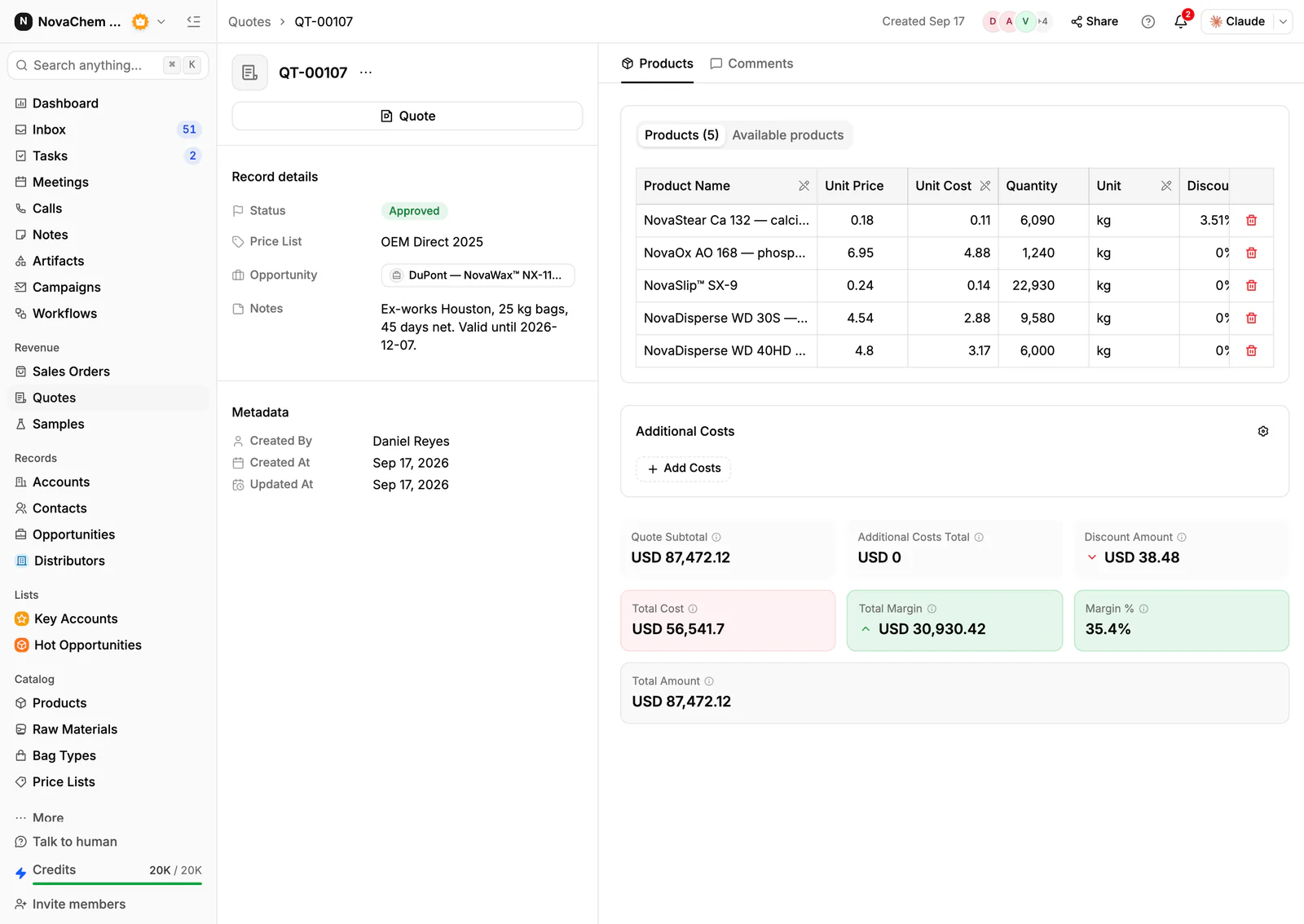
Workflows can create a follow-up task when a quote changes status, so an open distributor quote does not sit unchallenged. The daily digest in Slack, Telegram or WhatsApp lists tasks and follow-ups due. See also how to manage key accounts, since your top distributors are key accounts.
Frequently asked questions
How often should I meet my distributors?
Every two weeks for your top partners, monthly for the rest, and a longer quarterly review with each. The rhythm matters more than the exact numbers. Pick one you can keep for a year.
How do I stop distributors competing with each other?
Write a rule for who owns an end customer and share it with everyone. A common rule is that the first distributor to log the opportunity and ship a sample owns it for a fixed period. Enforce it the same way each time, even when it is awkward.
Should I sell direct to customers a distributor found?
Not without telling them. If a customer outgrows the distributor, agree a transition, such as a commission for a set period. Quietly going direct is the quickest way to lose that partner and make the others cautious.
What do I do with an underperforming distributor?
Start with a conversation about what is blocking them. Agree three actions and a review date. If nothing moves, reduce the territory, move the account to another partner or end the agreement under its terms.
Who should own the distributor relationship?
One named person with a back-up, who has the authority to agree prices, samples and support. Rotating contacts is the quickest way to lose a distributor's attention.