



















How to prospect for new B2B customers
How to prospect for new B2B customers: define who to target, build a list, reach out on several channels, and track every touch until they reply or say no.
 By the PromptLab team7 November 20265 min read
To prospect for new B2B customers, define exactly who you want, build a list of those companies and the right person in each, contact them on more than one channel with a message about their problem, and log every touch until they reply or say no. Prospecting is a routine, done in blocks every week, not a burst when the pipeline is empty.
This guide is for reps and founders at manufacturers and distributors. It pairs with how to build an ideal customer profile for the "who" and how to qualify B2B leads for what happens once someone replies.
Where new B2B customers come from
Most sources fall into five groups:
- Your existing customers. Referrals and introductions, covered in how to get referrals from B2B customers.
- Outbound. Email, calls, LinkedIn and messaging to companies you chose.
- Events. Trade shows and local industry meetings.
- Inbound. Web form enquiries and website visits. See how to capture leads from your website.
- Partners. Distributors, agents and suppliers who meet your buyers.
This guide centres on outbound, because it is the part you control.
Step by step: prospect in a routine
- 1
Define who you want
Write the profile: industry, size, what they buy, where they are and what makes them a good fit. Say "mid-sized paint manufacturers in the north-west that buy titanium dioxide and resin", not "manufacturers".
- 2
Build the list yourself
PromptLab has no built-in lead database, so source the list elsewhere: industry directories, trade show exhibitor and visitor lists, association member pages, LinkedIn searches, customs and tender notices and your own customers' suppliers. Put each company in a spreadsheet with a contact name, title, email or phone and where you found them.
- 3
Find the right person
For each company, find the person who buys or specifies what you sell. See how to find decision makers in a company.
- 4
Write a message about their problem
Open with what you noticed about them and what you can do, in three sentences. Mention a specific product or issue. See the cold email templates and cold call scripts.
- 5
Reach out on several channels
Use email, a call and LinkedIn or WhatsApp where your market uses it. A sequence might be: email on day one, LinkedIn connection on day two, call on day four, a second email on day eight, and a final short note on day fourteen. See how to write a sales email sequence.
- 6
Book prospecting time and protect it
Two blocks of 90 minutes a week beat an occasional day. Put them in the calendar and treat them like a customer meeting.
- 7
Log every touch and the outcome
Record who you contacted, how, when and what happened. Move replies to qualification, set a follow-up date for "later" and mark the rest as closed with a reason.
- 8
Review what works every month
Count messages sent, replies, meetings booked and deals started, by channel and by segment. Drop what does not work, double what does.
What to say in the first message
Keep it short and specific:
- Why you are writing to them, in one line.
- What you do that is relevant, with one concrete detail.
- One simple ask, such as a short call or a sample.
Don't attach a catalogue or ask for "15 minutes to introduce our company". Offer something they can say yes to in one line, such as a quote for a product they already buy.
Mistakes to avoid
- Targeting everyone. A list that is too broad produces generic messages and few replies.
- Giving up after one email. Many replies come after the second or third touch.
- Selling in the first line. Lead with their problem, then your product.
- Not logging touches. If it is not recorded, two reps will contact the same buyer.
- Prospecting only when the pipeline is thin. The gap between starting and the first deal is weeks, so keep the routine going.
How to tell if prospecting is working
Track four counts each month: contacts reached, replies, meetings or samples booked, and deals started. If replies are low, the message or the list is wrong. If meetings are low, the ask is too big. If deals are low, the qualification step needs work. Change one thing at a time so you can see what moved the number.
A worked example
Say a food-ingredient supplier targets 200 bakery manufacturers. It builds the list from association members and exhibitor lists, with a buyer's name for 120. It sends a four-touch sequence: email, LinkedIn note, call, email. In the first month 120 contacts get all four touches, 14 reply, 6 take a sample and 2 become quotes. The sales lead sees that bakeries with more than one site replied most, and narrows the next list to those.
How PromptLab helps
PromptLab does not supply prospect lists, a lead database or company search, so the list comes from you. Everything after that is in the CRM. Import your list from CSV or Excel, with columns matched to fields and missing companies created as accounts. Then run an email campaign: multi-step sequences up to 10 steps, sent from your own mailboxes (rotating up to 20), with A/B variants, a sending window, daily limits and a three-week ramp-up for new mailboxes. A campaign stops when the contact replies or the email bounces.
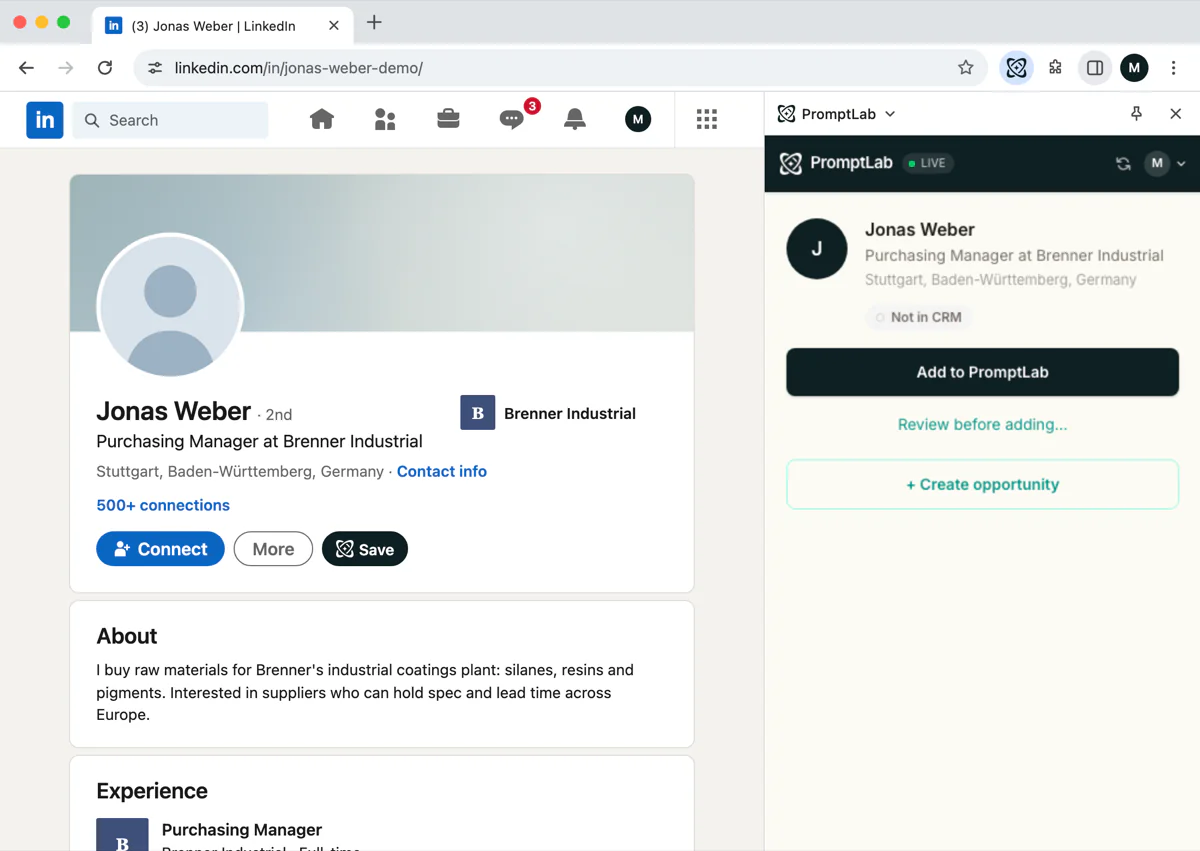
The Chrome extension saves LinkedIn profiles, drafts opening messages and creates tasks. Replies by email, WhatsApp or Telegram land in one shared Inbox. Website visitors who arrive from your campaign emails are named, with the pages they read.
Frequently asked questions
What is B2B prospecting?
Finding and contacting companies that might buy from you, before they have asked. It includes building a target list, reaching out and qualifying those who respond.
How many prospects should I contact each week?
Enough to fill your pipeline at your real conversion rates. Work backwards from the deals you need and the share of contacts that reply, and use your own numbers.
Which channel is best for prospecting?
A mix. Email scales, calls get faster answers and LinkedIn or WhatsApp suit buyers who use them. Test by segment and keep what gets replies.
Where do I find a list of prospects?
Directories, exhibitor lists, association members, LinkedIn searches, tender notices and your customers' own suppliers. Build it with a contact name and role for each company.
How many follow-ups should I send a prospect?
Four to six touches over two to three weeks is common. Stop when they reply, ask to stop or the sequence ends, and note a date to try again later.