



















How to hire your first sales rep
Hire your first sales rep without guessing: know when you are ready, define the job, pay fairly, interview with a real task, and set up the first 90 days.
 By the PromptLab team7 November 20267 min read
To hire your first sales rep, make sure you can already sell the product yourself and write down how, define one clear job, choose between an experienced and a hungry hire, pay a base plus a commission tied to margin, test candidates with a real sales task, and start them with a 90-day plan. The first rep fails mostly because the founder never wrote down how deals are won.
This guide is for founders and sales managers at small manufacturers and distributors. For the next stage, when you want a team, read how to build a B2B sales team. Once you have an offer accepted, use the sales rep onboarding checklist.
Are you ready to hire?
Hire when these are true:
- You have won deals yourself and know why buyers said yes.
- You can describe the process: where leads come from, what happens at each stage, and what a typical deal looks like. If not, see how to set up a B2B sales process.
- There is more demand than you can handle, or a market you cannot reach alone.
- You can pay for six months of a rep who is still learning.
- You can spend time coaching. A first rep needs hours each week from you.
If none of these is true, a rep will not rescue the sale. They will repeat your confusion at your expense.
Define the job before you write the advert
"Sales rep" can mean four different jobs. Pick one.
| Role | What they do | Fits when |
|---|---|---|
| Account manager | Looks after existing customers, reorders, upsell | You have customers who need attention |
| New business rep | Finds and wins new customers | You have a repeatable way to win them |
| Inside sales | Sells by phone, email and messaging | Orders are small and many |
| Field or technical sales | Visits plants, runs trials, writes specifications | The sale needs technical credibility |
Write a one-page job description with the territory or segment, the products, the type of buyer, the targets and what the rep may decide on price. A rep who must ask you about every discount will be slow.
Experienced hire or junior hire?
- Experienced rep from your industry. Faster to start, knows buyers, expects higher pay and may bring habits. Best when you need results this year.
- Rep from a nearby industry. Understands B2B selling, learns your products. Often a good value.
- Junior hire. Cheaper, eager and trainable, but needs much more of your time. Best when you can coach and the product is easy to explain.
For a first hire, many founders pick the nearby-industry rep with a good record, because a deep industry contact book matters less than the ability to follow a process.
Step by step: run the hiring process
- 1
Write the scorecard
List four or five things the hire must be good at, such as discovery questions, follow-up discipline, handling price objections, and working from a CRM. Score every candidate against the same list.
- 2
Write an honest advert
Say what you sell, who buys it, how deals are won, what the pay is made of and what support the rep will get. Candidates who like the honest version are the ones to meet.
- 3
Screen with a short call
Ask them to describe their last sale from first contact to delivery. Good reps tell a specific story with numbers, names of roles and next steps. Vague stories are a warning.
- 4
Interview with a real task
Give a short exercise: a mock enquiry from a buyer asking for a price on a product you sell. Ask them to write the reply and to say what they would ask on a discovery call. See how to run a discovery call for what good looks like.
- 5
Check references
Speak to a former manager. Ask what the person did with a missed target, and whether they would hire them again.
- 6
Make the offer clear in writing
Base salary, commission rules, targets, territory, notice period, and who owns the accounts they build. Ambiguity here becomes an argument in month six.
How to pay a first sales rep
Pay has two parts: a base that covers living costs, and a variable part that rewards what you want more of.
- Base plus commission is the usual structure. A common split is more base for a new, unproven territory, and more variable for an established one.
- Tie commission to margin, not only revenue. A rep paid on turnover will discount to win. Paid on gross profit, they protect your price.
- Pay on collected money if late payment is a risk in your market.
- Add a ramp period. In the first two or three months the rep has no pipeline, so guarantee part of the variable pay.
Use the sales commission calculator to test a plan on example orders, and read what a sales commission is for the common models. Setting realistic targets is covered in how to set sales targets.
The first 90 days
Plan for the new rep
Review their pipeline once a week, for thirty minutes, from the same screen every time. Look at open deals, next steps and tasks that are overdue. How to measure sales rep performance lists the numbers worth watching, and how to write a sales playbook turns your process into something a new hire can read.
Mistakes to avoid
- Hiring to escape selling. The founder still has to sell and coach for a long time.
- Giving no leads and no process. A rep needs accounts, samples, price lists and a playbook on day one.
- Pay that rewards the wrong thing, such as turnover at any price.
- Waiting too long to judge. Decide at ninety days whether the numbers and habits are heading the right way.
- Keeping the customer history in your head. Put it in the CRM so the rep inherits it.
How PromptLab helps
A new rep needs the history of your customers on the first morning. In PromptLab every account brings together its contacts, deals, emails, meetings, notes and files, with its quotes, samples and sales orders linked to it, and the Overview shows the last order and how often the customer reorders. The rep reads the story instead of asking you. Email capture from Gmail, Outlook or your own mail server, and the shared Inbox for email, WhatsApp and Telegram, show what was said to each buyer.
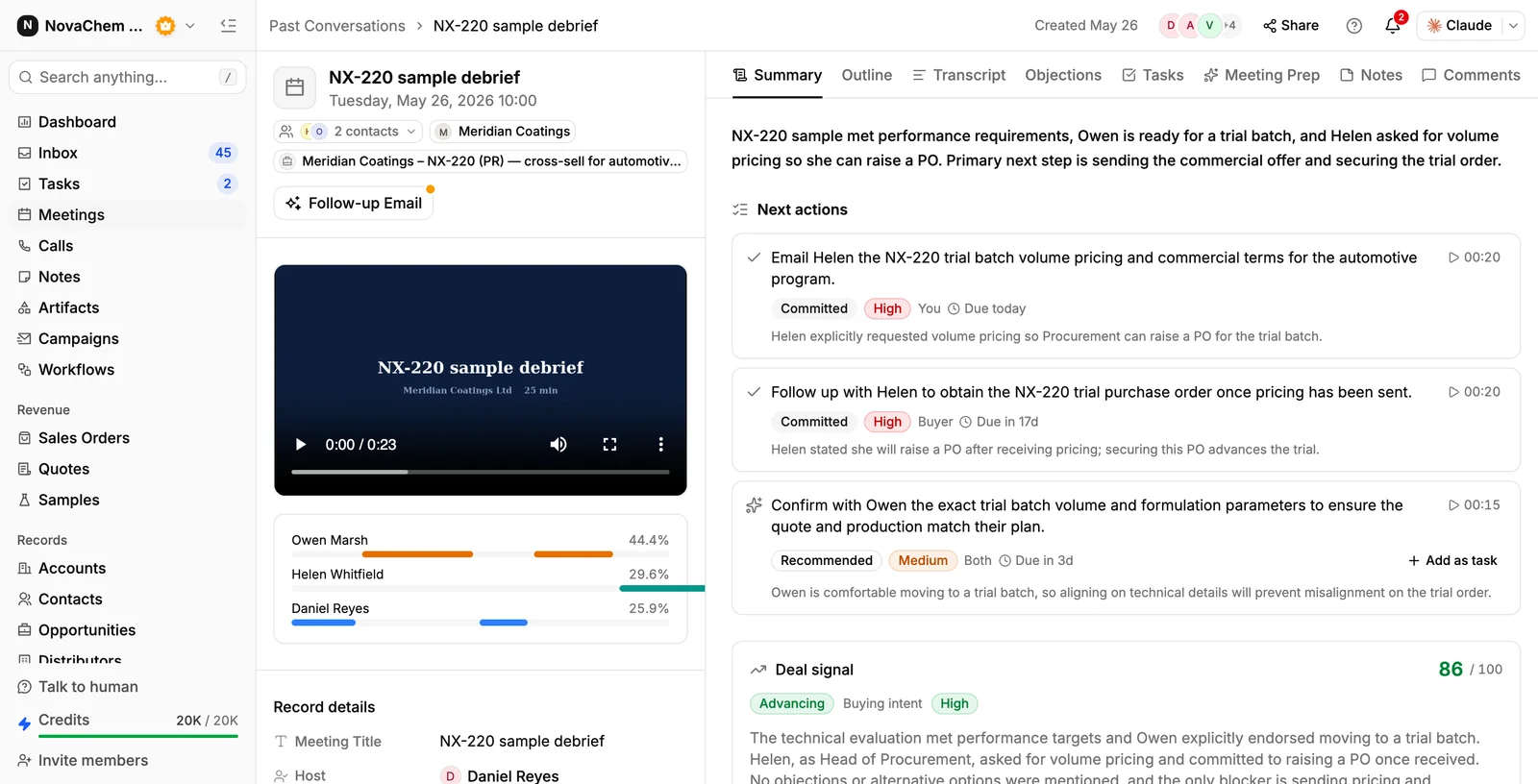
Meetings are recorded and transcribed, with AI summaries and pre-meeting briefs on each meeting's Prep tab, so a new rep can listen to how you handle a customer and prepare for their own calls. Action items become tasks. Reports and dashboards on pipeline and revenue give you the weekly review, and on Professional the rep call scorecard shows AI call rating and skills against the team average.
Round robin, a workflow action, lets teammates take turns owning new deals or accounts, so new enquiries are shared out between you and the new rep from the start.
Frequently asked questions
When should a founder hire their first sales rep?
When you have won deals yourself, can describe how, and there is more demand or territory than you can cover. Also when you can pay for several months of ramp-up and spend hours each week coaching.
Should the first sales rep be experienced or junior?
An experienced rep from your industry starts faster and costs more. A rep from a nearby industry is often the best value. A junior needs a lot of coaching, so hire one only if you have the time.
How should I pay my first sales rep?
Base salary plus commission, ideally on gross margin so the rep does not give discounts away. Guarantee part of the variable pay for the first two or three months while the pipeline builds.
How long before a new sales rep produces results?
It depends on your sales cycle. If a deal takes months from enquiry to order, expect the first orders late in the first half-year. Judge activity and pipeline habits at ninety days, not only closed revenue.
What should I give a new rep on day one?
Product knowledge, price lists, sample stock, a list of accounts, your best quotes and recorded calls, access to the CRM and a plan for the first ninety days. Starting with nothing makes even a good rep slow.