



















How to write a sales plan
How to write a B2B sales plan in seven parts: goal, customers, products, pipeline maths, actions, team and review. A short worked example for a distributor.
 By the PromptLab team7 November 20265 min read
To write a sales plan, set a revenue goal for the period, split it by customer group and product, work out the pipeline and activity needed to reach it, assign actions to named people with dates, and set a review rhythm. A good plan fits on three pages and is opened every week. A plan nobody reads is just a document.
This guide is for sales leaders at manufacturers and distributors writing the plan for the year or the next quarter. It builds on how to set sales targets and links to how to write a sales playbook, which covers how reps sell, where this plan covers what the team will sell and to whom.
What goes in a sales plan
Seven parts are enough:
- Goal. The revenue number and any margin or volume target.
- Starting point. Last period's sales by customer, product and region.
- Target customers. Which accounts you will grow, keep and win.
- Product focus. What you will push and why.
- Pipeline maths. How many deals, at what value and win rate, make the number.
- Actions and owners. Who does what by when.
- Review. How you will check progress, and what triggers a change.
Step by step: write the plan
- 1
Start from last year, honestly
Pull sales by customer and product for the last twelve months. Note which accounts grew, which shrank and which went quiet. Say the business sold $2.4 million, of which twelve accounts made up 70 percent. That tells you where the plan is exposed.
- 2
Set the goal and split it into three
Say the goal is $2.9 million. Split it: how much from existing accounts at the same level (keep), how much from growth in those accounts (grow), and how much from new customers (win). A plan that relies on new customers for most of its growth needs a larger pipeline than one built on existing accounts.
- 3
Choose target customers and products
Name the top accounts to grow and the segments to enter, using your ideal customer profile. Pick two or three products to focus on. A plan that tries to sell everything to everyone is not a plan.
- 4
Do the pipeline maths
Work backwards. If the new-customer goal is $400,000, your average first-year order is $20,000 and about one in four qualified deals closes, you need about 80 qualified deals, so around 7 a month. Use your own numbers. See what is pipeline coverage and the pipeline coverage calculator.
- 5
List the actions with owners and dates
Turn each goal into actions: "Visit the ten largest accounts by 31 March", "Launch the distributor email campaign in February", "Attend the April trade show with a meetings list". One name and one date each.
- 6
Set the targets by rep
Split the number across the team using each rep's territory or accounts, their ramp and their history. See how to manage sales territories.
- 7
Decide how you will review it
Weekly: pipeline and activity. Monthly: revenue against the plan. Quarterly: whether the plan is still the right plan. Use the pipeline review checklist and the year-end sales planning checklist.
How to keep the plan in use
A plan survives if it shows up in the weekly routine. Open it at the start of each pipeline review and ask three questions: are we on track for the number, which action is behind, and what has changed? Put each rep's targets and actions where they see them every day, and mark an action done only when the result exists, such as the meeting held or the quote sent.
At the end of each quarter, write two lines: what worked and what to change. After a year, those notes become the start of the next plan.
A short worked example
Say a chemicals distributor sets $3 million for next year, up from $2.6 million. It plans $2.3 million from existing accounts, $400,000 from growth in its top ten and $300,000 from new customers. It focuses on two product lines where margin is best and picks one new region. It needs about 15 new first orders of $20,000, so it sets a target of 60 qualified deals. It plans one trade show, a quarterly email campaign to a segment and two visits a month per rep. Each rep gets a named account list, and the plan has a review on the first Monday of every month.
Mistakes to avoid
- A goal with no pipeline. If the maths says you need 80 deals and you have 20, change the plan now.
- Averages for everyone. A new rep and a ten-year rep do not carry the same number.
- Too many priorities. Three product pushes, not nine.
- No owners. "We will visit key accounts" gets done by nobody.
- Never reviewed. Put the dates in the diary on day one.
How PromptLab helps
PromptLab gives you the data for step one and the tracking for steps five to seven. Sales orders sit on each account, so a report on sales orders by account gives you last year's sales by customer, and each account's Overview shows its lifetime sales and last order. Reports and dashboards on pipeline and revenue show how the year is going, and a report chart can draw your target as a line. Deals have an owner, an estimated value, expected volume and a next follow-up date, and an expected close date can be added as a custom date field. Tasks hold the actions from the plan, and a daily digest in Slack, Telegram or WhatsApp lists tasks and follow-ups due.
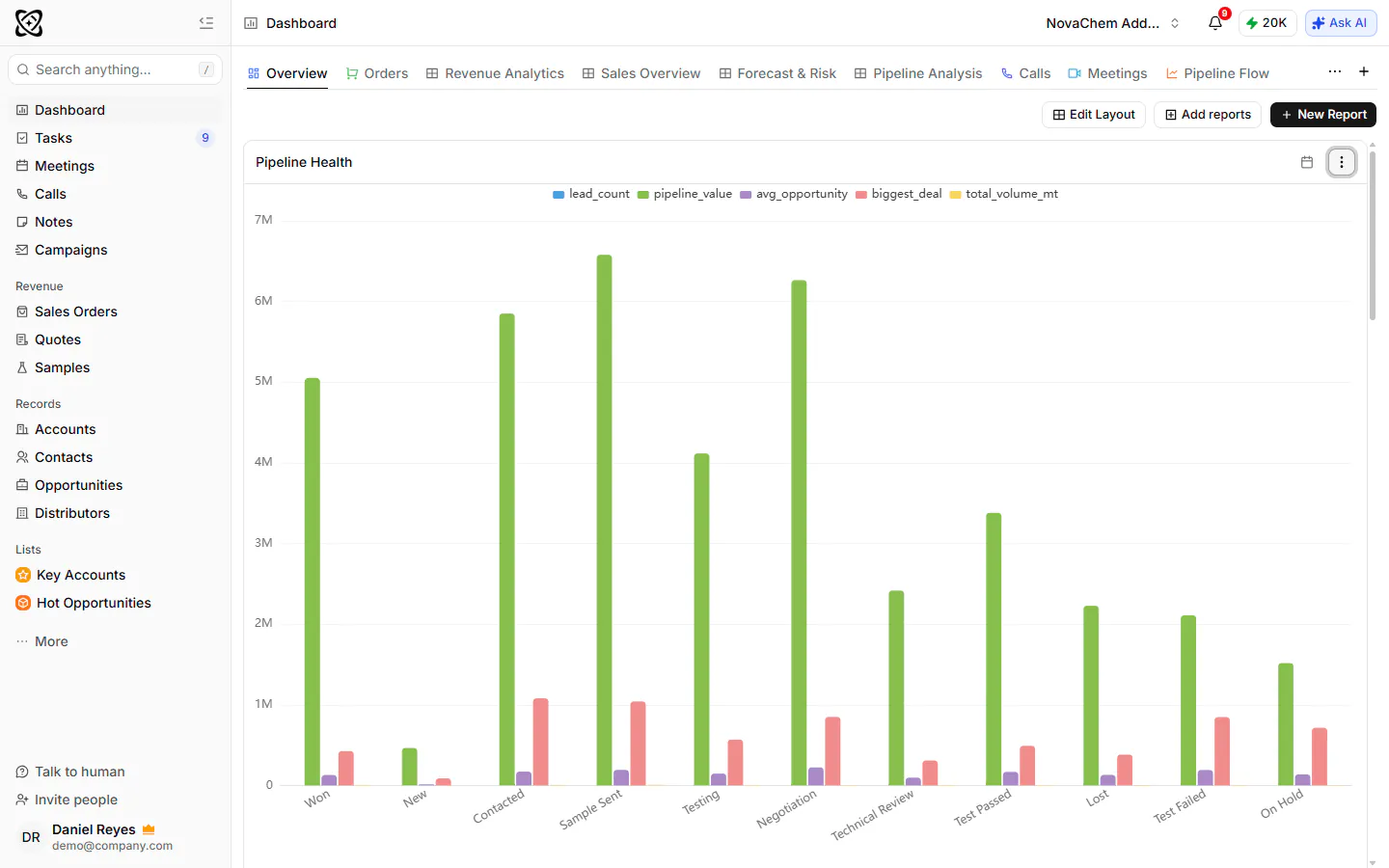
PromptLab has one deal pipeline per workspace, so segment by stage, owner, lists and custom fields rather than separate pipelines. Share a dashboard by a read-only link when you review the plan with the owners.
Frequently asked questions
What is a sales plan?
A short document that sets the revenue goal for a period and says which customers, products, activities and people will deliver it, with dates and a review rhythm.
How long should a sales plan be?
Three pages is enough for most teams. If it is longer, it is hard to review and nobody opens it.
What is the difference between a sales plan and a sales strategy?
Strategy is the choice of where to compete and why. The plan is the numbers, actions, owners and dates that follow from it.
How often should I update a sales plan?
Check it weekly through the pipeline, review it monthly against revenue, and rewrite it quarterly if your assumptions have changed.
Who should write the sales plan?
The sales leader writes the first draft with input from reps and the finance side. Reps should see their own number and actions before it is final.